
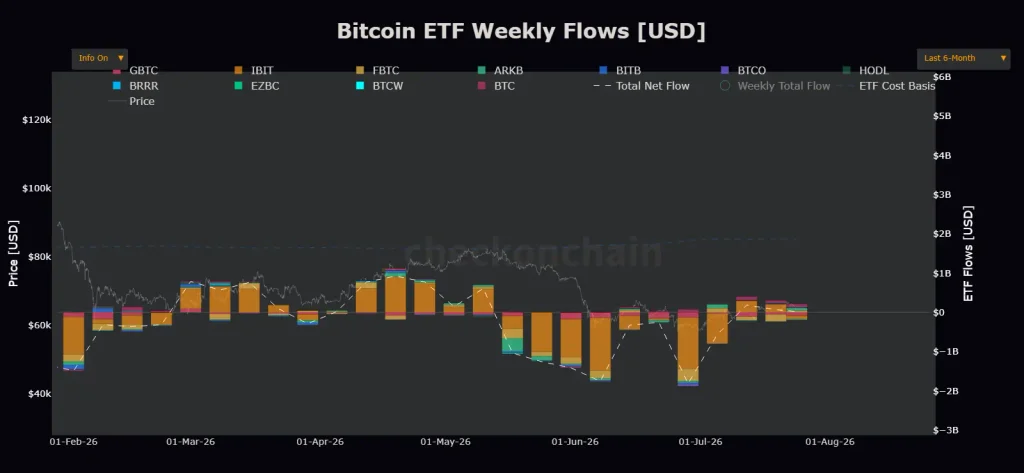
During the week ending July 24, Bitcoin ETFs managed to hold onto the green for the third consecutive week by posting net inflows of $18.2M, cementing a truce after the sharp crash at the end of June. However, institutional euphoria hit the brakes significantly compared to the $68.1M influx from the previous week, taking a direct hit from the escalating conflict in the Persian Gulf and its looming punishment on US inflation.
Geopolitics and Oil: The Federal Reserve’s Handbrake
The abrupt deceleration in the pace of ETF accumulation is no coincidence. The macroeconomic board grew complicated again after the resumption of clashes in the Persian Gulf, a trigger that shot crude oil prices up to the $100 per barrel barrier last week.
For traditional markets and risk assets, expensive oil translates immediately into a resurgence of inflationary pressures in the United States. This forces the Federal Reserve to rethink its strategy, putting the fear back on the table that interest rates will stay restrictive for longer or face a new upward adjustment, while strengthening the US dollar globally.
Price X-Ray: Between a Solid Rebound and Cost Basis
Despite this adverse backdrop, the digital safe-haven asset showed enviable resilience. This week’s positive capital flow found bitcoin trading above $64,630, a slight pullback from the previous week’s $64,500, yet holding firm inside a technical rebound channel that kicked off from $57,800.
Nevertheless, the bullish momentum slammed into a solid wall of technical resistance located at $67,300, preventing any further acceleration. In this context, key on-chain metrics like the ETF cost basis currently sit at $85,059. This means that while the mid-term structure seeks to heal wounds, bitcoin currently trades at an attractive discount compared to the average price at which major institutions acquired their positions.
In the short term, the evolution of Bitcoin ETFs will depend on stability in the Middle East and the macroeconomic data dictating the Fed’s pulse. If the resistance at $67,300 breaks with institutional volume, the market could leave the discount zone behind; otherwise, inflationary pressure will keep limiting the definitive breakout.
Disclaimer: This report serves educational and informational purposes only and does not constitute financial or investment advice under any circumstances. The crypto market is highly volatile; conduct your own research before making any capital decisions.

Communications Professional. Crypto Enthusiast. Economic Journalist. Bitcoiner & Altcoiner.