
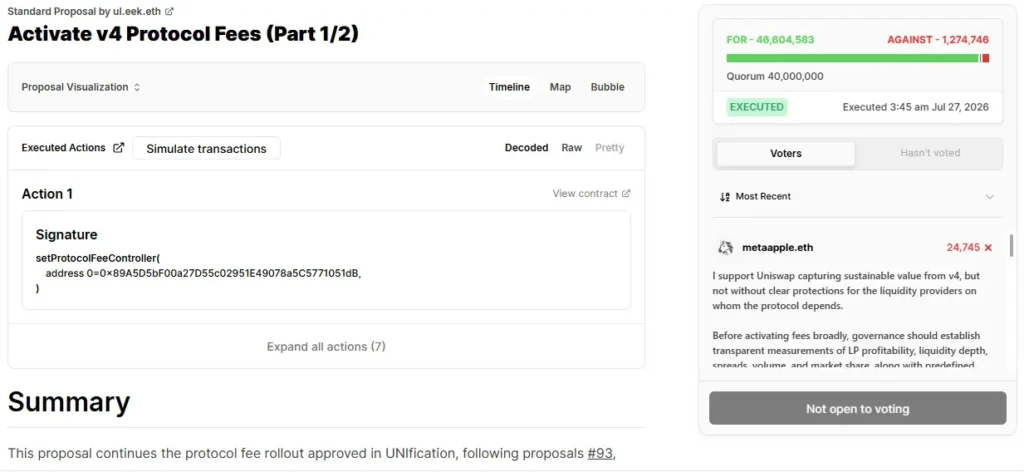
Uniswap governance marked a historical milestone after formally approving and executing the activation of protocol fees across its v4 architecture. With an overwhelming majority of 46.6M votes in favor against just 1.27M opposed, the proposal Activate v4 Protocol Fees (Part 1/2) successfully executed its on-chain changes. This move expands the token burn engine initiated during the “UNIfication” era, permanently turning the DEX’s liquidity into a recurring source of deflationary value.
Protocol Fees and v4: The Yield Evolution
Transitioning from v2 and v3 to v4 required a complete overhaul of the economic infrastructure. Unlike previous static models, v4’s modular architecture—driven by hooks—enables infinite, dynamic fee ranges.
To address this challenge, the community approved the deployment of the V4FeePolicy and V4FeeAdapter contracts. This decoupled structure allows governance to automatically determine the fee for any pool in real time without clogging the chain with individual updates:
V4FeePolicy: Calculates fee collection based on specific rules set by the DAO according to the pool’s “family.”
V4FeeAdapter: Executes the final fee inside the PoolManager and routes accumulated funds to each network’s TokenJar.
This first phase enables fees across three key families: static fee pools (without hooks), continuous auction pools (CCA), and pools with aggregator hooks. For the latter, to capture external flow, hooks will apply a 25x multiplier to their assigned fees, capping out at 250bps (2.5%).
Multichain Expansion and UNI Economic Health
This initial on-chain vote deployed the V4FeeAdapter as the official fee controller across 7 strategic networks: Ethereum, Arbitrum, Base, BNB Chain, Polygon, Optimism, and Robinhood Chain. The second proposal will cover the remaining 5 chains in the ecosystem (Celo, Soneium, Worldchain, X Layer, and Zora).
The financial flow is clear and automated: revenues captured in each network’s TokenJars will be converted and bridged to Ethereum mainnet to be irreversibly sent to the 0xdead address.
This mechanism deepens the trend seen last month when v2 and v3 logged a record 186,000 UNI burned in a single day. Integrating v4 volume adds a fundamental catalyst to the token, turning pure exchange activity into constant deflationary pressure.
Security, Governance, and Future Outlook
From a liquidity and risk management perspective, deploying the protocol fee system via discrete curves aims to avoid squeezing liquidity providers (LPs). Featuring progressive scales—ranging from 0.01bp for razor-thin margin pairs up to 100bps for pools with LP fees exceeding 55bps—Uniswap aims to calibrate value capture without pushing capital toward rival AMMs.
The vote’s success confirms the maturity of decentralized governance in 2026: the future of banking no longer focuses merely on issuing tokens, but on capturing and consolidating real value through an efficient multichain architecture.
Disclaimer: This article is strictly for informational and analytical purposes. It does not constitute financial, investment, or any other type of advice.

Graphic design student. Illustrator. Exploring cryptography and blockchain, and creating NFTs.