

Despite the volatility triggered by the conflict between the United States and Iran and rising crude oil prices, on-chain data reveals a decisive trend: more than $1.06B in BTC flowed out of exchange platforms over the last 30 days, signaling a phase of aggressive institutional accumulation in the face of ETF liquidations.
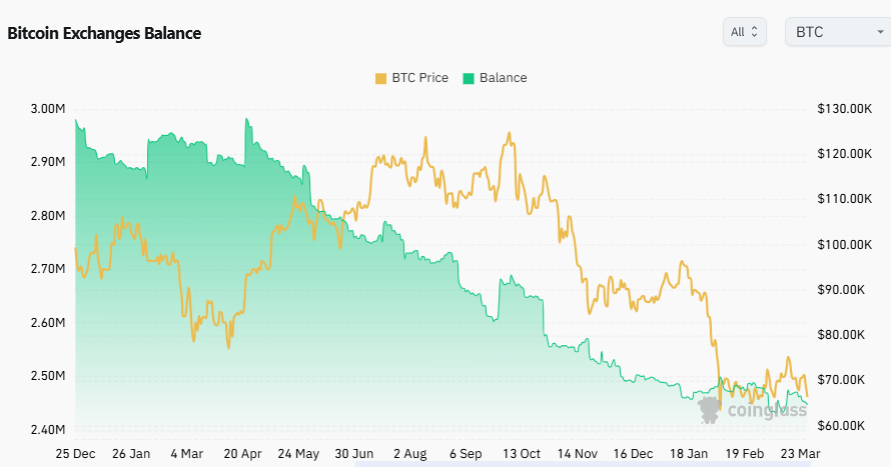
Massive Outflow: Exchanges Are Running Out of Inventory
Analysis of the Bitcoin network shows a deflationary trend in the supply available within exchanges. In the past week, the net balance dropped by -17,671.68 BTC, consolidating a monthly outflow of -32,626.43 BTC.
This metric is vital for understanding the market: when bitcoin moves from an exchange to cold wallets, selling pressure decreases. While giants like Binance recorded an outflow of -40,487.50 BTC and Bitfinex saw -28,430.48 BTC leave, the liquid supply is shrinking drastically, setting the stage for a potential “supply shock.”
The Contrast: Coinbase and the ETF Factor
It is not all outflows. Coinbase shows inverse behavior with an inflow of +$3.66B (approximately +61,036.91 BTC) over the last 30 days. What is the cause of this? Primarily, ETF flows.
In the face of wartime uncertainty, many institutional investment vehicles initiated profit-taking or position liquidation due to fears of geopolitical risk. These coins flow toward custodians (such as Coinbase), contrasting with native investors who prefer to withdraw their funds from Binance or OKX for long-term storage.
Price Analysis: Below Cost Basis
Currently, the price of bitcoin remains above $60,000.00, resisting the impact of the massive deleveraging that began in October 2025. However, on-chain data suggests the asset is trading below the basic acquisition costs for many mining groups and recent whales.
Historically, when the price of bitcoin sits near or below the production cost or average cost basis, we find ourselves in a “deep value” zone. The accumulation detected in exchange outflows reinforces the thesis that “smart money” is buying the fear.
Unexpected Resilience
The Bitcoin ecosystem is demonstrating remarkable maturity. While oil prices rise and the drums of war beat, the migration of coins from exchanges to private storage suggests that holders view this asset as a long-term store of value, independent of short-term derivatives volatility.
Disclaimer: This analysis is for informational purposes and does not constitute financial advice. Investments in crypto-assets carry high risk.

Communications Professional. Crypto Enthusiast. Economic Journalist. Bitcoiner & Altcoiner.