

The Ethereum ecosystem is navigating a moment of intense technical duality. While the number of weekly active addresses saw an 18.71% cooldown, the network just recorded unprecedented levels of transactional activity. With a 30-day moving average (30D MA) at all-time highs, bitcoin is no longer the only asset grabbing headlines; the operational efficiency of the leading smart contract network suggests that, although fewer “people” are moving, machines and protocols are working at full throttle.
Transactions at All-Time Highs: Ethereum’s Engine Doesn’t Stop
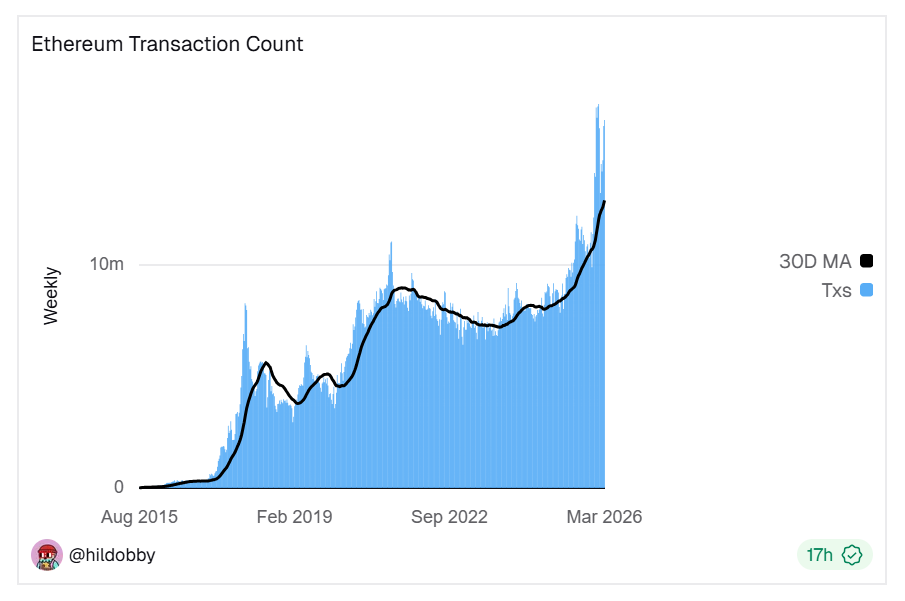
The latest data from @hildobby’s dashboard on Dune reveals an impressive figure: the 30-day moving average for transaction counts reached an all-time high of 19,927,734. At the close of March 23, 2026, weekly transactions stood at 16.53M, representing a slight but steady increase of 1.62%.
This transactional boom, which saw its absolute peak on February 2 with over 17.2M transactions in a single day, is a bullish signal of technical adoption.
What does increasing transaction volume mean? Basically, it indicates greater network utility. This isn’t just speculation; an increase in Tx suggests more dApp interactions, higher volume on decentralized exchanges (DEXs), and constant smart contract execution. It is the “heartbeat” confirming the network is alive and being used for productive purposes.
The Active Addresses Paradox
Despite the transaction frenzy, Weekly Active Addresses fell to 2.94M, an 18.71% decline. How is it possible to have more activity with fewer users? The answer lies in the maturity of the ecosystem:
Automation: Fewer human users performing manual operations, but more bots and protocols executing multiple complex transactions.
Consolidation: Current users are significantly more active than in previous cycles.
Even so, the long-term trend remains robust. The 30D MA of active addresses (excluding smart contracts) holds at an all-time high of 3.16M, proving that the “loyal” user base is stronger than ever, even as the influx of “New Users” dropped from its January peak.
TVL: The $53.2B Wall
Capital does not seem to fear congestion. The Total Value Locked (TVL) on Ethereum, according to DefiLlama data, appreciated 1.15% over the last week, reaching $53.2B. This growth in locked value acts as an anchor of confidence; investors prefer to keep their capital within Ethereum protocols, taking advantage of yield and network security while waiting for transactional activity to translate into greater buying pressure for the asset.
Market Impact: What to Expect?
In the short term, network saturation could put pressure on gas fees, driving migration toward Layer 2 (L2) solutions. However, the fact that transactional volume is at all-time highs while TVL grows positions Ethereum as indispensable infrastructure. If the network manages to absorb this demand without pricing out retail users, the impact on the underlying asset’s price will inevitably be positive in the medium term.
Disclaimer: This article is for informational purposes and does not constitute financial advice. Investments in crypto-assets carry high risk.

Communications Professional. Crypto Enthusiast. Economic Journalist. Bitcoiner & Altcoiner.