

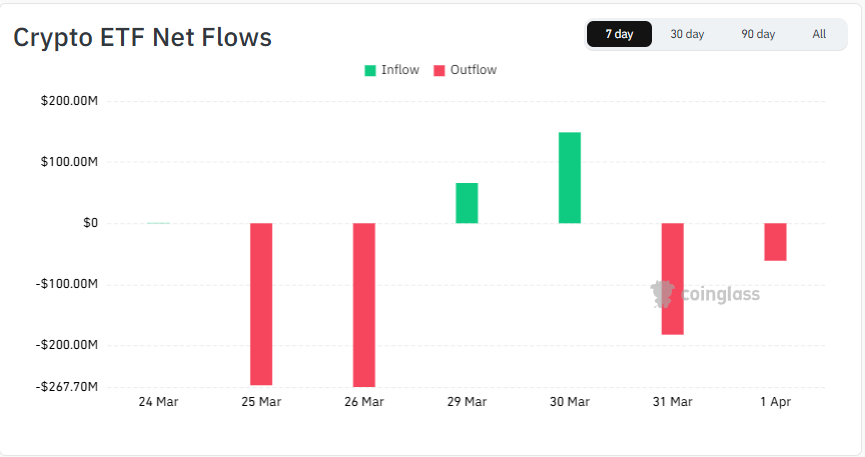
Geopolitical volatility has returned to the center of the financial stage. Following the escalation of conflict between the United States and Iran and the blockade of the Strait of Hormuz, the crypto ETF market recorded a net outflow of -$61,235,386 in the last session. However, behind this institutional pessimism, bitcoin demonstrated astonishing resilience, holding firm above $65,600 and absorbing selling pressure, positioning itself as an unexpected safe-haven asset against falling stocks and gold.
“Risk-off” Sentiment Dominates Wall Street
Coinglass data reveals a clear trend: risk appetite is waning. Over the last five trading days, crypto ETFs have accumulated total outflows of -$310,558,752. This movement suggests that large funds are seeking liquidity or more traditional havens in the face of rising oil prices.
Despite this capital drain, the sector’s total AUM (assets under management) remains robust at $118,996,000,222, indicating that while there are specific outflows, the institutional capital base remains committed to the sector for the long term.
Bitcoin vs. Ethereum: A Confidence Gap
The report highlights a fascinating divergence between the two market giants:
Bitcoin ETFs: Despite the negative climate, Bitcoin funds managed to capture +$9,000,000 in net inflows. Fidelity’s FBTC fund led the charge with a daily inflow of +$7,300,000, reinforcing the narrative of bitcoin as “digital gold” in times of war.
Ethereum ETFs: Ether is experiencing the flip side of the coin. Ethereum ETFs suffered a hemorrhage of -$71,200,000, with the ETHA fund recording an outflow of -$46,700,000. Investors seem to view the Smart Contracts network as an asset more closely tied to technological growth than value preservation.
On the other hand, emerging assets such as Solana (+$900,000) and XRP (+$64,614) maintained marginal positive flows, resisting the general market’s red tide.
The Geopolitical Factor: Gold vs. Oil vs. Bitcoin
The crisis in the Persian Gulf has disrupted traditional investment manuals. Normally, gold would be the direct beneficiary, but on this occasion, the precious metal is faltering alongside equities. Bitcoin, conversely, acted as a sponge, absorbing supply from those fleeing traditional markets. The fact that the price remains above $65,600 in the midst of an armed conflict is a sign of institutional maturity for Bitcoin technology.
A Quarter of Contrasts
Although the last quarter shows a massive outflow of -$2,953,722,129, the monthly outlook remains positive with +$361,673,759. We are facing a technical correction driven by geopolitical fear. If bitcoin manages to maintain the $65,000 support, the safe-haven narrative will strengthen, drawing flows back into crypto ETFs once the dust in the Strait of Hormuz begins to settle.
Disclaimer: This report is for informational purposes and does not constitute financial advice. Investments in crypto assets carry high risk.

Communications Professional. Crypto Enthusiast. Economic Journalist. Bitcoiner & Altcoiner.