

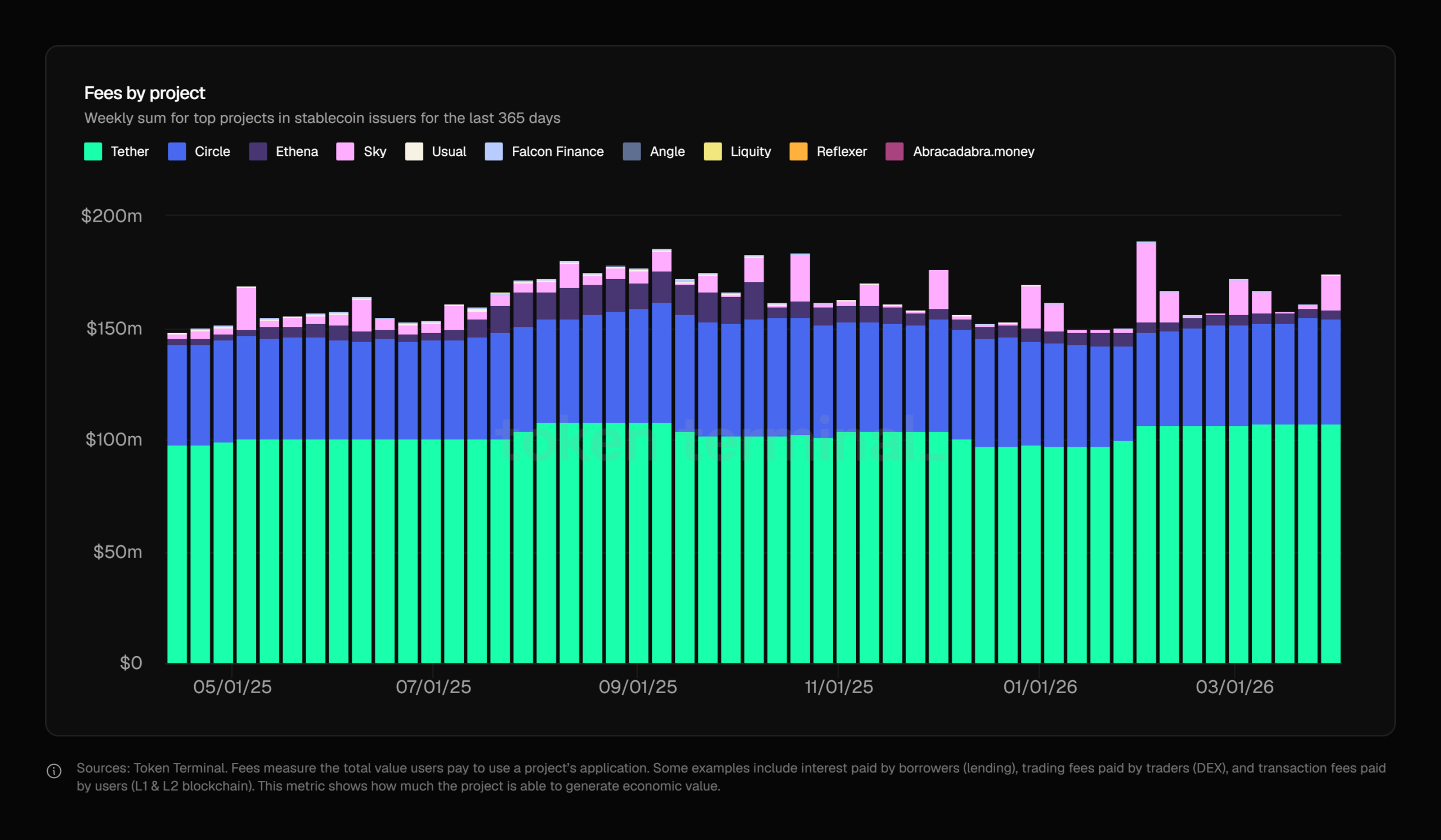
The stablecoin market has consolidated its position as the true “goose that lays the golden eggs” of the crypto ecosystem. According to the latest data from Token Terminal, top issuers generated massive fee revenue over the last 365 days, led by an untouchable Tether that neared $5.4B. This cash flow not only validates the utility of these assets but also underscores the global market’s dependence on programmable liquidity.
The Duopoly Sustaining the Ecosystem
The “Fees by Project” chart reveals a striking reality: the market is highly concentrated. Tether (USDT) and Circle (USDC) operate in a league of their own, together totaling more than $7.8B in economic value generated in a single year.
Tether ($5.4B): Continues to be the undisputed king, fueling liquidity in emerging markets and exchanges.
Circle ($2.4B): Remains steady as the preferred choice for the institutional sector and regulated DeFi.
This gap relative to other competitors demonstrates that, in the world of stablecoins, trust and the network effect are more valuable assets than any isolated technical innovation.
Ethena and Sky: The Yield Challengers
Further down the table, but showing aggressive growth, we find Ethena ($367.7M) and Sky ($350M) (formerly Maker/DAI). Unlike traditional models backed by Treasury bills, these projects managed to capture value through native yield strategies and arbitrage.
The emergence of Usual ($22.5M) and Falcon Finance ($20.7M) suggests there is still room for niche protocols offering more direct revenue distribution to their users, challenging the “winner-takes-all” model of centralized issuers.
What Does This Mean for the Investor?
When we look at these figures, we don’t just see “fees”—we see business model validation. While other sectors of the industry depend on price speculation regarding assets like bitcoin, stablecoins generate constant revenue regardless of whether the market is bullish or bearish.
The fact that Tether generates more economic value than many traditional banks is a clear signal: financial infrastructure is migrating toward open protocols. For the user, this means the payment system of the future is already here and is extremely profitable.
Short-term Impact: Competition for yield is expected to intensify, orcing Circle and Tether to offer clearer incentives to retain their market share against more agile DeFi protocols.
Disclaimer: This article is for informational purposes only and does not constitute financial advice. Investments in crypto-assets carry high risk.

Communications Professional. Crypto Enthusiast. Economic Journalist. Bitcoiner & Altcoiner.