
The Real World Asset (RWA) ecosystem on the Ethereum network consolidates its operational dominance by reaching an on-chain market capitalization of $16.188B and an active circulating value of $14.853B. Backed by 53 asset issuers, this financial inflow represents an unprecedented convergence between Traditional Finance (TradFi) and the DeFi environment, where sovereign debt and precious metals take control of liquidity on the distributed ledger.
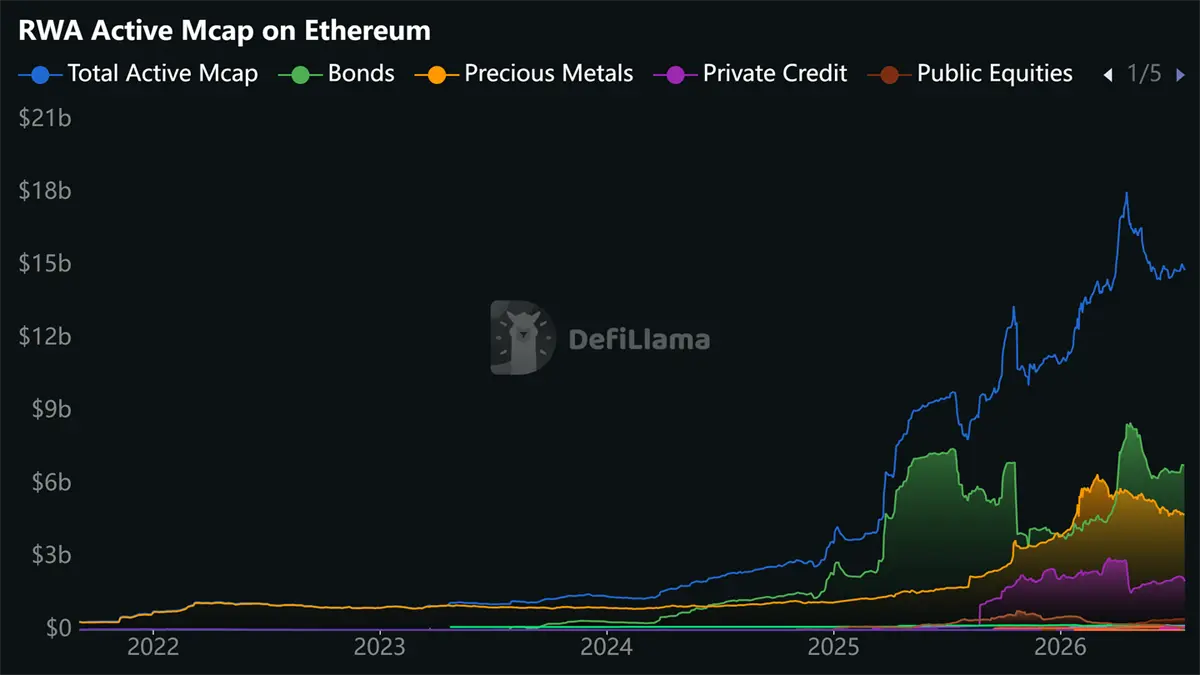
Metrics Analysis: Breakdown of Institutional Capital
Ethereum’s on-chain metrics reveal a clear standardization of the sovereign and corporate financial instruments currently undergoing tokenization. The distribution of the $15.004B active value registered in mid-July 2026 highlights the dominant structure of the sector:
| Asset Category (RWA) | Market Cap / Total Value | Percentage / Impact |
|---|---|---|
| Bonds & Banking (Bonds) | $6.800B | Dominant sector driven by U.S. Treasury Debt. |
| Precious Metals | $4.738B | Inflation hedge through gold and silver tokenization. |
| Private Credit | $2.216B | Direct corporate financing on-chain. |
| Public Equities | $452.38M | Integration of traditional stock markets. |
| Reinsurance & Other Subsectors | ~$797.62M | Stock market indices, venture capital, and real estate. |
Key Performance Metric:
DeFi Active TVL: $1.978B of RWA capital sits actively deposited and generating yield across lending protocols, collateralized loans, and decentralized liquidity markets.
The “Why” Behind the Data: What It Means for Ethereum’s Health
1. Liquidity Maturity and Institutional Trust
A Total RWA Onchain Mcap of $16.188B compared to a DeFi Active TVL of $1.978B indicates that the market is in an early yet solid phase of integration. Capital does not move on-chain purely for speculation; the presence of $6.8B in bonds and $4.738B in precious metals confirms that institutions seek the legal clarity, composability, and operational efficiency of the Ethereum network to custody safe-haven assets.
2. Collateral Efficiency and Yield Generation
Using nearly $2.00B in RWAs as active collateral within the DeFi ecosystem shows how these assets unlock immediate liquidity without liquidating traditional positions. Users can deposit tokenized bonds or precious metals to mint stablecoins or gain leverage in decentralized lending markets, optimizing capital efficiency.
3. Risk Management and Issuer Governance
With 53 issuers operating on Ethereum, diversification mitigates centralized counterparty risk. However, because these assets rely on physical or legal off-chain collateral, system resilience depends heavily on regular reserve audits, Proof of Reserves verification via decentralized oracles like Chainlink, and smart contract resilience against execution failures.
The historical trend of the RWA market on Ethereum confirms a structural acceleration since late 2024, locking in strong momentum in 2026. Ethereum reaffirms its status as the foundational infrastructure for global institutional liquidity. Moving fixed-income instruments and commodities into DeFi protocols not only stabilizes total value locked, but also lays the groundwork for a transparent, programmable, 24/7 global banking architecture.
Disclaimer: This analysis serves strictly informational and educational purposes. It does not constitute investment advice, financial recommendations, or a solicitation to buy/sell digital assets or tokenized financial products. Conduct your own research (DYOR) and evaluate your risk tolerance before interacting with DeFi protocols.

Communications Professional. Crypto Enthusiast. Economic Journalist. Bitcoiner & Altcoiner.