
The Bitcoin Hashprice Index posted an impressive rebound over the past month, driven directly by the U.S. Department of the Treasury’s announcement to double government bond buybacks to curb debt yields. This macroeconomic measure equals a massive liquidity injection into the traditional financial system, weakening the dollar and unleashing a bullish wave in risk assets that directly benefits the crypto ecosystem and the daily profitability of bitcoin mining.
Macroeconomic Liquidity: The Treasury Combo Rescuing Miners
To understand this movement, you must look beyond trading screens. Last week, the Treasury Department’s decision to double its bond buyback operations aimed to contain the escalation of public debt yields. In practical terms for the global economy, this injects fresh cash into the system, weakens excessive dollar strength, and pushes capital toward alternative safe havens and risk assets like cryptocurrencies.
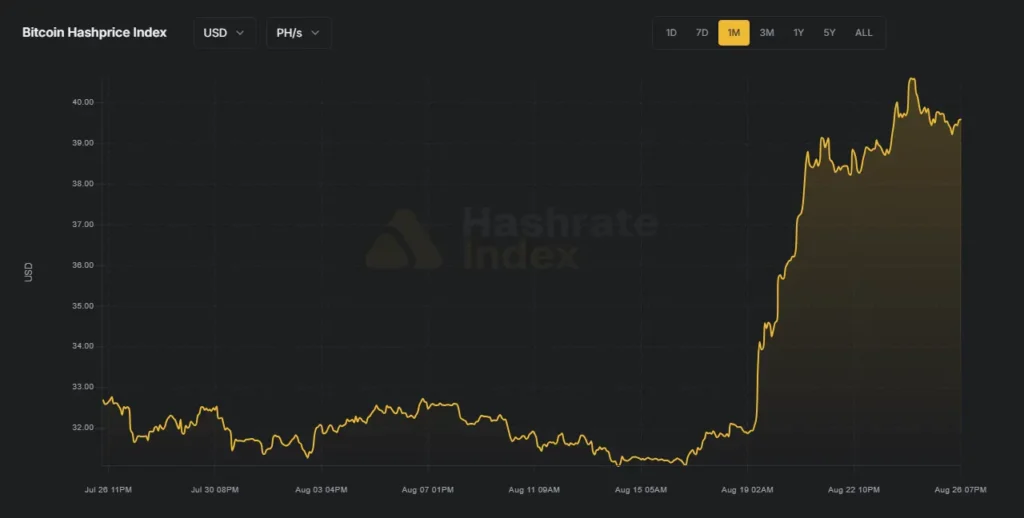
This macroeconomic relief translated into an immediate jump for the Bitcoin Hashprice Index, which climbed from around $32.69 at the end of July to stabilize at $39.58 per PH/s per day by the end of August, according to data from Luxor’s chart. This behavior demonstrates how traditional monetary policies continue triggering an immediate domino effect on the Bitcoin network infrastructure.
What Is Hashprice Really and Why Does It Matter in the Ecosystem?
Created by the firm Luxor, the Bitcoin Hashprice Index is a fundamental metric quantifying the expected value of a mining power unit (SHA-256) per day; in other words, how much money a miner can expect to earn for each operational petahash per second. For enthusiasts and analysts, this tool serves as a financial thermometer for the industry.
The index draws power from four critical variables changing with every mined block:
The price of bitcoin: Its correlation is strictly positive.
Transaction fees: Higher network congestion and usage bring greater complementary rewards.
The block subsidy: The base issuance stipulated by the protocol.
Network difficulty: The only factor maintaining an inverse or negative correlation, because higher competition makes mining costlier.
Using a 144-block simple moving average (SMA) to smooth fee volatility, the Bitcoin Hashprice Index reflects with surgical precision the golden moment hardware operators experience following last week’s liquidity injection.
The surge in the Bitcoin Hashprice Index highlights the deep connection between miners’ financial health and global central bank policies. Short-term, this liquidity injection mitigates operating pressure on mining facilities, allowing them to capitalize on a more favorable macroeconomic environment. However, the sustainability of this performance depends on whether the U.S. Treasury manages to stabilize debt markets without stoking medium-term inflationary ghosts.
Disclaimer: This article serves purely educational and informational purposes. It does not constitute financial or investment advice. Cryptocurrency markets and digital mining carry high risks; conduct your own research before committing capital.

Communications Professional. Crypto Enthusiast. Economic Journalist. Bitcoiner & Altcoiner.