
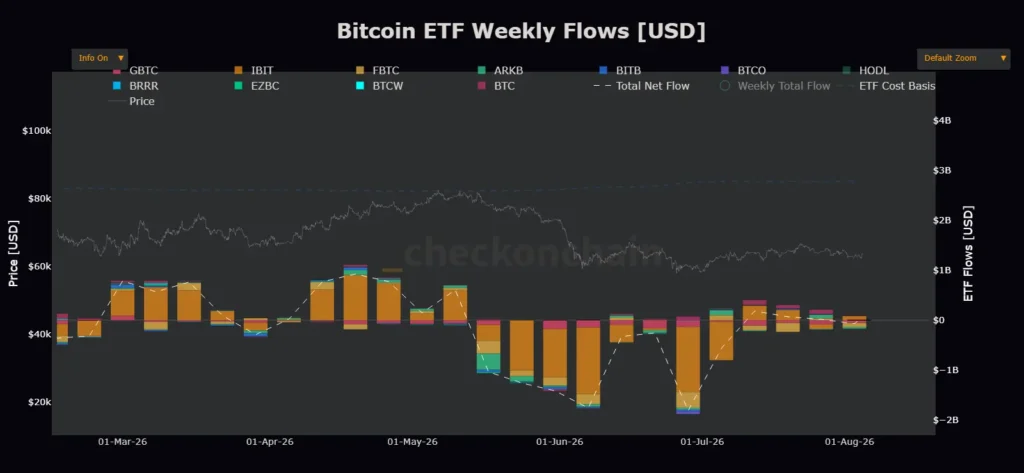
Bitcoin ETFs reached a turning point last week by recording a net capital outflow of $68.9M, breaking a three-week streak in positive territory that, paradoxically, already showed clear signs of exhaustion by dropping from the initial $184.2M down to barely $18.2M. Amid this institutional cooling, favorable macroeconomic data—such as lower-than-expected inflation—collided head-on with a hardware wallet security incident that triggered investor alarms.
The Institutional Pulse: From the Bitcoin ETF Slowdown to Macroeconomics
Large capital behavior usually dictates the ecosystem’s real pulse, and CheckOnChain numbers reflect a clear transformation in Wall Street’s narrative. After weeks of increasingly lukewarm money inflows, the scale tipped into the red with $68.9M pulled out of Bitcoin ETF products. This movement demonstrates that institutional investors are adopting a defensive stance, scrutinizing every step amid global uncertainty.
Curiously, this brake contrasts with a macroeconomic scenario that, on paper, should have been a party for risk assets. The Federal Reserve maintained interest rates at 3.75%, while its Chairman, Kevin Warsh, reaffirmed the commitment to the 2% inflation target, downplaying external market pressure. Although three FOMC members suggested tightening by betting on a rate hike, relief arrived the next day with the Core PCE Price Index MoM indicator, which landed at a comfortable 0.1% (below the expected 0.2% and the prior reading of 0.3%). Lower inflationary pressure and stable rates: the perfect ingredients that, atypically, failed to save the weekly balance of Bitcoin ETFs.
Security Under Fire: The Achilles’ Heel Slowing Down Optimism
If macro data played in favor, why did Bitcoin ETFs suffer net outflows? The answer seems to lie in investor psychology and an inescapable factor: trust in custody.
An operational flaw related to seed phrases in Coldcard wallets unleashed an untimely security incident. News like this strikes directly at the waterline of mass adoption, reminding traders that the weakest link in the chain is usually human and technical private key management. When the fear of losing personal funds intersects with market volatility, caution becomes the only viable strategy for retail investors and large funds alike.
What to Expect in the Short Term?
The market sits at a tactical crossroads. On one hand, falling inflation and the Fed pause alleviate the macroeconomic fears that punish digital assets so heavily. On the other hand, the temporary loss of traction in Bitcoin ETFs and cybersecurity scares impose a wait-and-see mode. In the short term, we will see a consolidation phase where attractive prices drive on-chain accumulation, but the market will demand clear signs of institutional strength and custody robustness before reclaiming the bull run.
Disclaimer: This article is for educational and informational purposes only and does not constitute financial advice of any kind. Cryptocurrency trading carries high risks of loss; consult a certified advisor before investing.

Communications Professional. Crypto Enthusiast. Economic Journalist. Bitcoiner & Altcoiner.