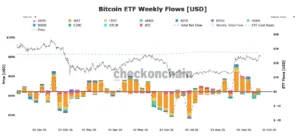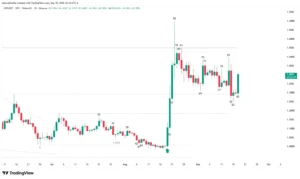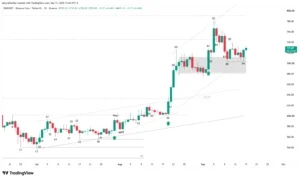

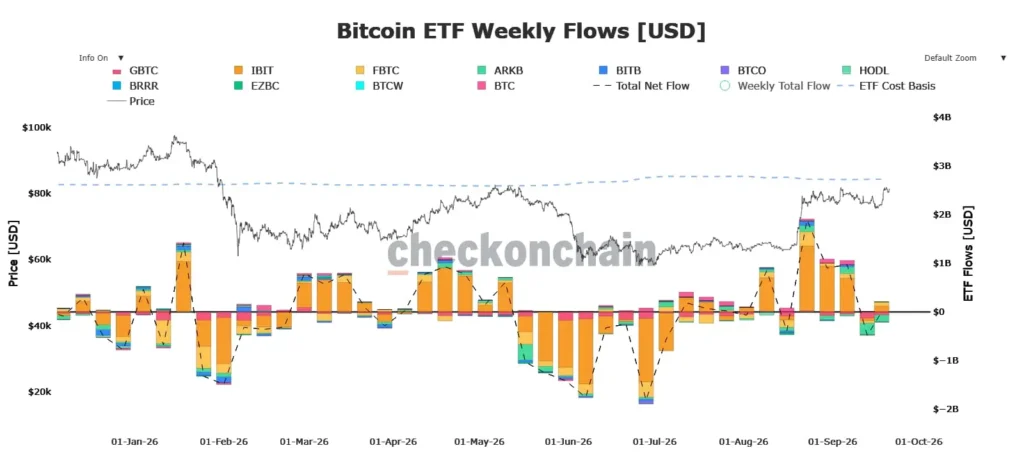
Net capital inflows for bitcoin closed the week in negative territory at $-7.1M, displaying a notable slowdown following the $-482M crash recorded in the previous period. The leading cryptocurrency weathered the macroeconomic onslaught marked by the Federal Reserve’s (Fed) decision and tensions in the Middle East, solidly consolidating above the key level of $74,000 and flirting with the psychological barrier of $80,283.
Boiling Macroeconomics: Oil, Rates, and Bitcoin
The crypto ecosystem no longer operates on an island. Over the past five weeks, risk appetite for Bitcoin ETFs experienced a significant brake, contrasting sharply with the euphoria of the week of August 23, when funds captured a massive peak of $1.88B.
This temporary cooling coincided with a high-tension geopolitical and inflationary cocktail: the persistent crisis in the Strait of Ormuz pushed oil above $100, while the Federal Reserve executed a new 25-basis-point increase in interest rates. Far from succumbing to traditional bearish panic, the digital asset’s resilience surprised Wall Street.
Liquidity to the Rescue and the Consolidation Range
Why did bitcoin withstand the interest rate blow? The answer lies in parallel global liquidity flows. Simultaneously with the Fed’s move, the United States Department of the Treasury announced Treasury bond buyback operations, injecting fresh oxygen into the financial system.
Thanks to this liquidity injection, bitcoin avoided breaking through its critical floors and shielded itself at a solid neutral price level. Currently, the asset trades within a range defined by a ceiling of $81,300 and a robust support at $76,500, making it clear that bears lose strength with every attempt at a deep correction.
In the short term, bitcoin’s capacity to absorb such complex macroeconomic shocks confirms its maturity as a reserve asset. If US Treasury liquidity continues neutralizing the Fed’s restrictive policies, the path toward the definitive breakout of resistance at $82,000 could reactivate sooner than expected.
Disclaimer: This report is for educational and informational purposes only and does not constitute financial advice or investment recommendations. Cryptocurrencies are highly volatile assets; conduct your own research before trading.

Communications Professional. Crypto Enthusiast. Economic Journalist. Bitcoiner & Altcoiner.