
During the first half of 2026, the decentralized platform Hyperliquid demonstrated the true potential of real-world assets (RWAs). Following a technical upgrade that enabled community-created markets, the outbreak of the geopolitical conflict with Iran on a Saturday served as the catalyst: with traditional stock exchanges closed, Hyperliquid became the sole global refuge for trading commodities and equities in real time, driving a massive wave of organic adoption that is redefining decentralized trading.
The Litmus Test: When Wall Street Closes Its Doors
The narrative surrounding the tokenization of real-world assets (RWAs) used to feel like a distant theory—until geopolitics collided head-on with the limitations of the traditional financial system. Following Hyperliquid’s 2025 upgrade, which allowed users to launch decentralized equity and commodity markets, the platform lay in wait for its true catalyst.
That moment arrived during the attacks in Iran. While Wall Street remained in the dark over the weekend, Hyperliquid provided uninterrupted liquidity to traders desperate to hedge their exposure in the oil market. Necessity transformed decentralized RWAs into an indispensable hedging tool.
New Users Who Are Here to Stay
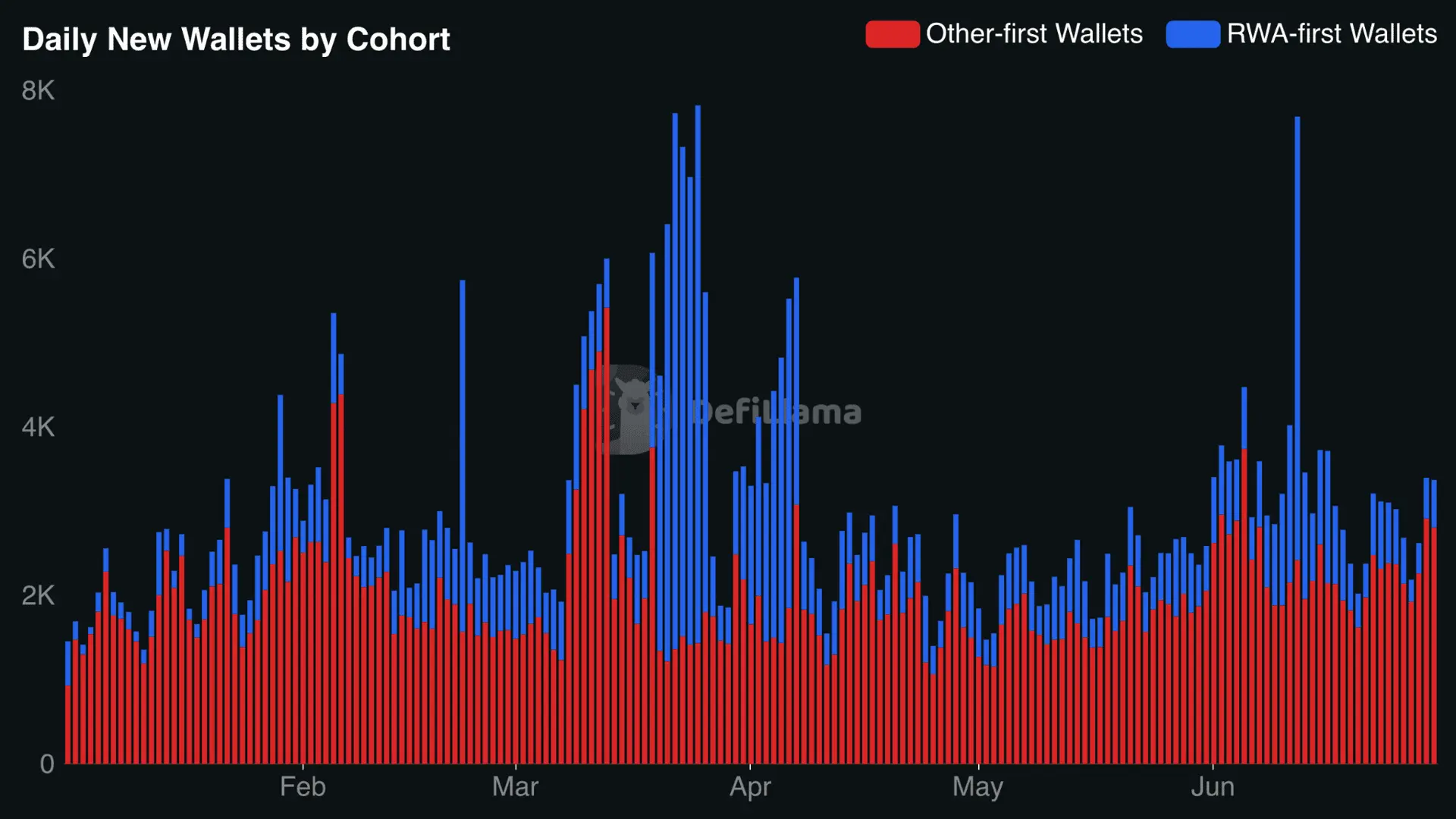
According to an in-depth analysis of DefiLlama Research Notes, this adoption isn’t just a simple capital shift among seasoned crypto traders. Real-world assets are serving as a massive acquisition funnel for the DeFi ecosystem.
Between January and June 2026, more than 534,000 new wallets interacted with Hyperliquid for the first time. Surprisingly, 169,000 of these addresses (31.7%) made their trading debut directly in an RWA market rather than turning to standard crypto pairs.
The retention rate among these traders is striking: out of the $111.6B in total volume generated by this cohort, roughly $93.2B (83.6%) was concentrated exclusively in real-asset derivatives, leaving just $18.3B for traditional crypto perpetual contracts.
The Impact on Value Generation
The steady flow of trades translates directly into market volume. The $111.6B contributed by RWA-drawn users accounted for 31.5% of the $354.2B generated by all new users on Hyperliquid during the first six months of the year.
This trend proves that integrating traditional finance (TradFi) with decentralized infrastructure not only diversifies product offerings, but also builds a solid foundation for sustainable operational growth.
The surge of RWAs on Hyperliquid validates DeFi’s core premise: global markets need 24/7 uptime. As macroeconomic and geopolitical events continue to unfold outside traditional banking hours, demand for 24/7 decentralized platforms will solidify real-world assets as the definitive bridge between traditional finance and Web3.
Disclaimer: This article is strictly for informational and educational purposes. It does not constitute financial advice, an investment recommendation, or a solicitation to trade digital assets or derivatives. Always conduct your own research before making financial decisions.

Graphic design student. Illustrator. Exploring cryptography and blockchain, and creating NFTs.