
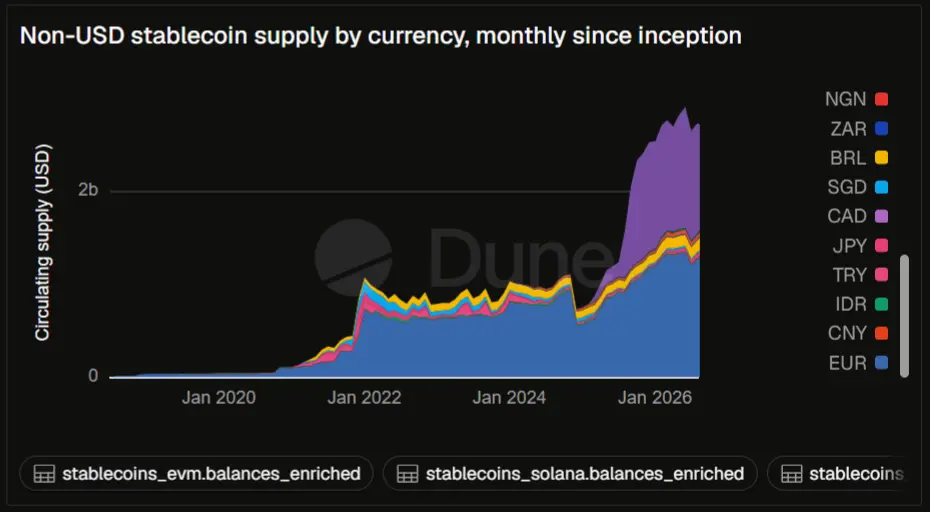
The non-US stablecoin market is experiencing exponential growth, surging from $110M in 2020 to $2.7B, with the euro cementing its position as the second most tokenized global currency. Even though the euro’s market share contracted relative to its past dominance—dropping from three-quarters of the market to less than half—euro stablecoins position themselves as the strongest fiat alternative against dollar hegemony.
The Non-Dollar Stablecoin Map: What Is Happening?
When we analyze global liquidity on the blockchain, we usually think exclusively of USDT or USDC. However, recent Dune data shows that 66 non-USD stablecoins exist across 24 different currencies. This decentralized ecosystem scaled up to $2.7B in total circulating supply, proving that the demand for local hedging and monetary sovereignty outside the United States is a latent reality for traders and institutional funds.
The euro’s case is particularly interesting. Although the euro captured 75% of this niche at the end of 2024, its current share sits below 50%. This does not mean euro stablecoins are dying; on the contrary, their absolute supply grew, but diversification accelerated with the entry of currencies like the Russian ruble with $1.1B or the Brazilian real with $136.9M, reflecting accelerated geographic decentralization in crypto adoption.
De-Dollarization and Liquidity: The Strategic Role of Euro Stablecoins
For an investor focused on risk management, understanding euro stablecoin dynamics is vital. Fiat currency tokenization mitigates traditional exchange rate risk exposure and opens the door to decentralized financial (DeFi) instruments denominated in euros without traditional banking friction.
As traditional markets experience macroeconomic tensions, euro stablecoin adoption offers an escape hatch and diversification path. Although the dollar maintains its undisputed crown, the existence of a euro alternative with solid capitalization proves that appetite for multi-currency financial security has already found its infrastructure on the blockchain.
The growth of euro stablecoins and the multi-currency ecosystem marks a medium-term paradigm shift. Far from being a passing fad, foreign currency tokenization decentralizes systemic dollar risk and equips traders with more sophisticated tools to operate across different jurisdictions without depending on traditional banking.
Disclaimer: This article is purely informational and educational. It does not constitute financial advice or an investment recommendation. Do your own research before trading in crypto markets.

Graphic design student. Illustrator. Exploring cryptography and blockchain, and creating NFTs.