
The stablecoin ecosystem has crossed the $290 billion threshold, cementing its role as a key financial engine where protocols like Aave v3 and Morpho already manage over $8.6B in interest-bearing deposits. A recent Coin Metrics report reveals that, although these decentralized tools aim to compete head-to-head with US Treasuries, their yield and risk profiles vary drastically depending on the platform, protocol design, and chosen stablecoin, forcing millennial investors to look beyond mere speculation.
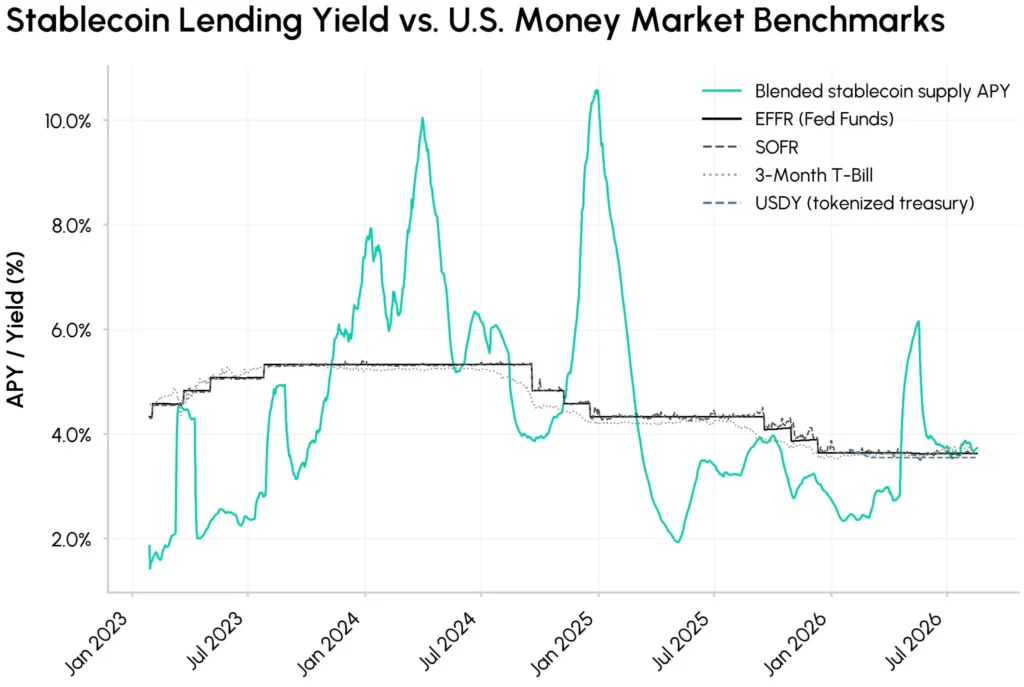
The Fine Line Between Traditional and On-Chain Yield
Traditional fixed-income products, such as short-term Treasury bills, move $1.2T daily under the premise of minimal risk. In parallel, the emergence of tokenized instruments like the BlackRock USD Institutional Digital Liquidity Fund (BUIDL) or the Franklin Templeton Money Market Fund (BENJI) bridges TradFi markets with the blockchain.
For the crypto investor, this unlocks instant settlement and programmability, but it also brings additional smart contract and liquidity risks that do not always translate into superior returns compared to the traditional economy.
Key Differences: The Same Stablecoin Across Different Protocols
Digital dollar yield is not universal. Taking deposited USDC as a benchmark, yields on Aave and Morpho show substantial differences due to their architectures:
Aave v3: It utilizes a pooled liquidity market, offering stable rates that, in the case of USDC, have traded at an average discount of 31 basis points compared to one-year Treasuries for much of 2026.
Morpho: It operates through isolated markets and curator-managed vaults. Its median USDC vault yields an average of 65 basis points above one-year Treasuries, albeit with 3.3 times higher volatility.
Stablecoins Versus Volatile Asset Lending
Although stablecoin yields sometimes pale in comparison to traditional fixed income, their performance vastly outperforms the logic of lending volatile assets like ETH or WBTC. Historical data shows that, since 2024, depositing USDC on Aave generated higher net yield earnings than lending ETH, protecting investors from price drawdowns and delivering a steady, predictable cash flow.
The growth of stablecoin protocols proves that decentralized finance is maturing toward real wealth-generation products. In the near term, interest rate arbitrage and risk management will dictate the mass adoption of these tools by investors.
Disclaimer: This article is for educational and informational purposes only and does not constitute financial or investment advice.

A leading source for crypto, Bitcoin, DeFi, NFTs, and blockchain technology. Join us to master the blockchain