
The most important micropayments network in the crypto ecosystem is flashing accumulation signals. Since January 2026, there has been a notable recovery in the amount of BTC deposited in Lightning Network channels, coinciding with an asset price correction. For analysts, this behavior suggests that the ecosystem is maturing and that the $60,000 bitcoin price zone could be building a solid new technical floor for the months ahead.
The Lightning Paradox: Lower Price, Higher BTC Capacity
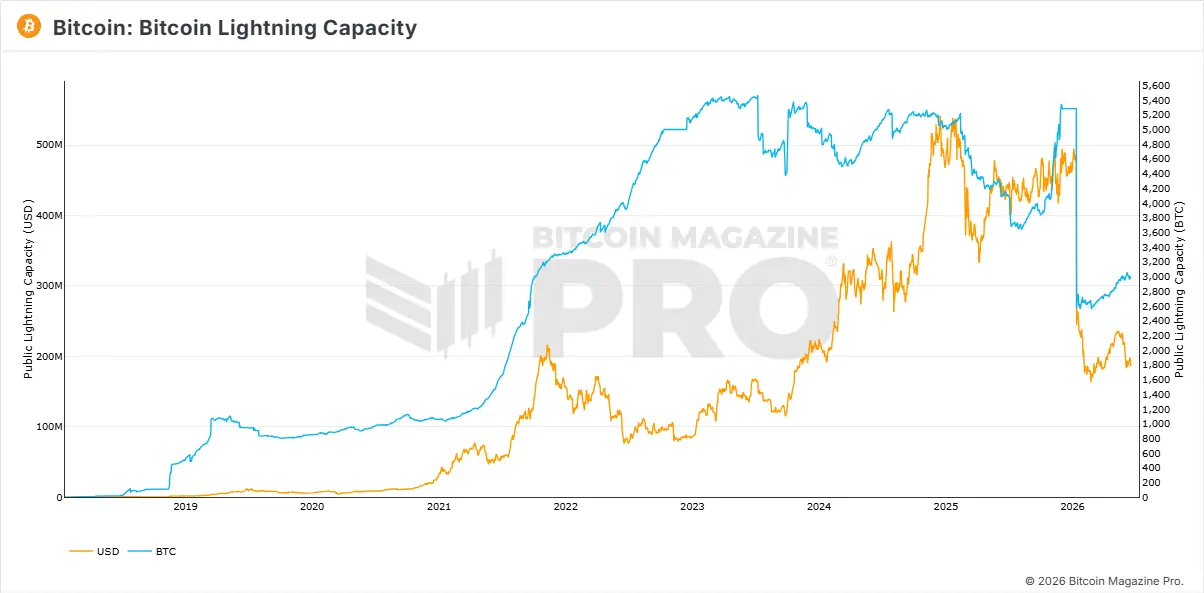
Recent market behavior has left a fascinating takeaway for investors. As the bitcoin price experienced pullbacks in the first half of 2026, the public capacity of the Lightning Network (measured in the amount of native tokens locked in the network) shows an aggressive rebound.
According to data from Bitcoin Magazine Pro, following a considerable drop in crypto-denominated liquidity during 2025, 2026 kicked off with a radical trend reversal. While capacity measured in U.S. dollars (USD) decreased due to asset depreciation—dropping from a peak above $263M in January 2026 to a range of $198M in June—the actual capacity in bitcoin jumped from 2,736 BTC to over 3,010 BTC over the same period.
This accumulation of satoshis in payment channels demonstrates that users and institutions prefer to hold and use their coins in Layer 2 solutions rather than liquidating them in the secondary market. Historically, this type of quiet accumulation occurs when market participants perceive that the asset is undervalued, setting the stage for the bitcoin price at $60,000 to act as an extremely strong psychological and technical support.
Infrastructure Resilience: Nodes Find Stability
An analysis of network robustness would not be complete without evaluating its decentralization. At the same time that liquidity in bitcoin rises, the number of LN nodes remains remarkably stable so far in 2026, hovering around the 14,700 active node mark.
Although a slight daily drop toward the 14,689 node zone is observed in mid-June, the macro perspective is positive. This current stability suggests a technical floor for the infrastructure, especially when recording a solid recovery from the lowest point of the previous cycle in July 2025, when the metric bottomed out near 13,882 nodes. The fact that the network retains nearly 1,000 more nodes than last year, despite price fluctuations, confirms that infrastructure operators have a long-term commitment to the Bitcoin protocol.
The Medium-Term Impact: Where Are We Headed?
The divergence between a correcting price and a strengthening network metric is typically a bullish indicator for investors focused on the fundamental value of the technology. Bitcoin’s Lightning Network is proving that it no longer relies exclusively on market euphoria to grow; its utility as a cheap, global settlement network continues to expand.
In the short and medium term, the combination of growing BTC capacity and a consolidated node base reduces selling pressure on major exchanges. If economic activity on Bitcoin continues to successfully migrate to these payment channels, the market could very soon validate the current price range as the ideal springboard for the next stage of the cycle.
Disclaimer: This analysis is strictly informational and educational. It does not constitute financial advice, an investment recommendation, or an offer to buy or sell any digital asset.

Communications Professional. Crypto Enthusiast. Economic Journalist. Bitcoiner & Altcoiner.