
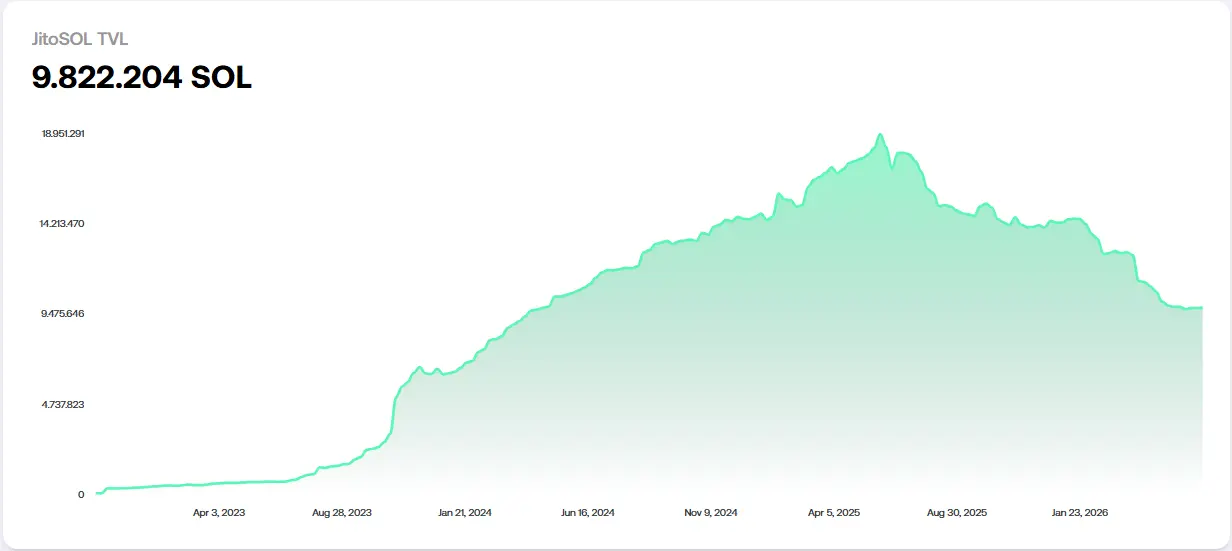
The decentralized finance (DeFi) landscape on Solana is undergoing a severe contraction. After hitting its golden era mid-last year, JitoSOL’s Total Value Locked (TVL) posted a 48.1% drop, falling from its all-time high of 18.95 million SOL in May 2025 to its current 9.82 million SOL. This massive liquidity withdrawal directly mirrors the broader crypto market correction, triggered by bitcoin pulling back from its all-time highs and a hawkish pivot from the US Federal Reserve (Fed) that keeps investors on edge over potential interest rate hikes.
The Perfect Storm: Bitcoin Pulling Back and a Hawkish Fed
The crypto market does not move in a vacuum. The price decline of SOL, Solana’s native token, accelerated in October 2025 due to macroeconomic macro factors. On one hand, bitcoin is undergoing a technical correction after hitting record-breaking highs, which historically dampens risk appetite for large-cap altcoins.
On the other hand, expectations that the Fed will implement a tighter monetary policy and hike interest rates make DeFi ecosystem yields less attractive, pushing institutional capital toward the safety of US Treasuries.
Yield Collapse: From the MEV Boom to Flat Waters
Capital flight from JitoSOL isn’t just about the underlying asset’s price; it stems from a drastic reduction in incentives for validators and users alike:
APY Slump: In February 2025, the protocol offered a total annualized percentage yield (APY) of 10.76%. Today, that figure has been cut in half, sitting at 5.41%.
The Disappearing “MEV Effect”: The Solana ecosystem previously saw a transaction and arbitrage frenzy that boosted Maximal Extractable Value (MEV) rewards. At its peak, the APY coming exclusively from MEV added an extra 2.71%. Currently, amid lower activity and stabilizing trading volumes, MEV APY collapsed to a marginal 0.12%.
Fewer Tips and Blocks: The protocol’s historical charts show that both bundle processing (transaction packages) and validator tips (which totaled over 375,759 SOL) have returned to baseline levels similar to early 2024.
Market Outlook: Where Is Jito Staking Heading?
In the short to medium term, Jito staking will remain tied to central bank monetary policy decisions and the Solana network’s ability to reignite retail hype. While a 5.41% rate on JitoSOL still beats traditional native staking options (thanks to residual MEV capture), the protocol will need bitcoin’s price to stabilize and global liquidity to return before it can target the psychological milestone of 15 million locked SOL again.
What Is Jito (JTO) and How Does It Work?
Jito is a Liquid Staking Derivative (LSD) protocol built on the Solana network that issues the JitoSOL token in exchange for user deposits. Unlike conventional staking, Jito stands out by utilizing an intelligent validation client that optimizes and captures Maximal Extractable Value (MEV). This means that, in addition to traditional interest earned for securing the blockchain network, the protocol distributes profits generated from the strategic ordering of transactions within blocks to JitoSOL holders. Its governance token, JTO, allows the community to vote on fees, treasury management, and system upgrades.
Disclaimer: This article is for informational purposes only and does not constitute financial advice or an invitation to invest. Crypto assets carry a high risk of volatility.

Communications Professional. Crypto Enthusiast. Economic Journalist. Bitcoiner & Altcoiner.