
The decentralized finance (DeFi) ecosystem is undergoing a quiet but deeply bullish metamorphosis for its fundamentals. The latest data from analytics firm DefiLlama reveals a counterintuitive phenomenon: despite decentralized exchange (DEX) trading volume plunging approximately 50% from January highs, crypto companies and protocols are earning more per unit of activity. The reason is a massive increase in the fee rate and the efficiency of total value locked (TVL), demonstrating that the ecosystem learned how to squeeze the maximum out of every on-chain dollar.
The Fee Paradox: Less Noise, More Substance
At the beginning of the year, DeFi protocols operated with an average fee rate of 0.68% on traded DEX volume. In recent weeks, that metric climbed sharply to reach an estimated 0.90%.
This means that, even though speculative euphoria cooled by half, total fees collected by platforms remained stable. For investors and market makers, the takeaway is straightforward: every dollar of remaining volume today generates 40% more in net fees than in January. The purge of low-quality speculative trades left the path clear for organic, higher-value transactions where users are willing to pay for precise executions.
The Awakening of Idle Capital in Web3
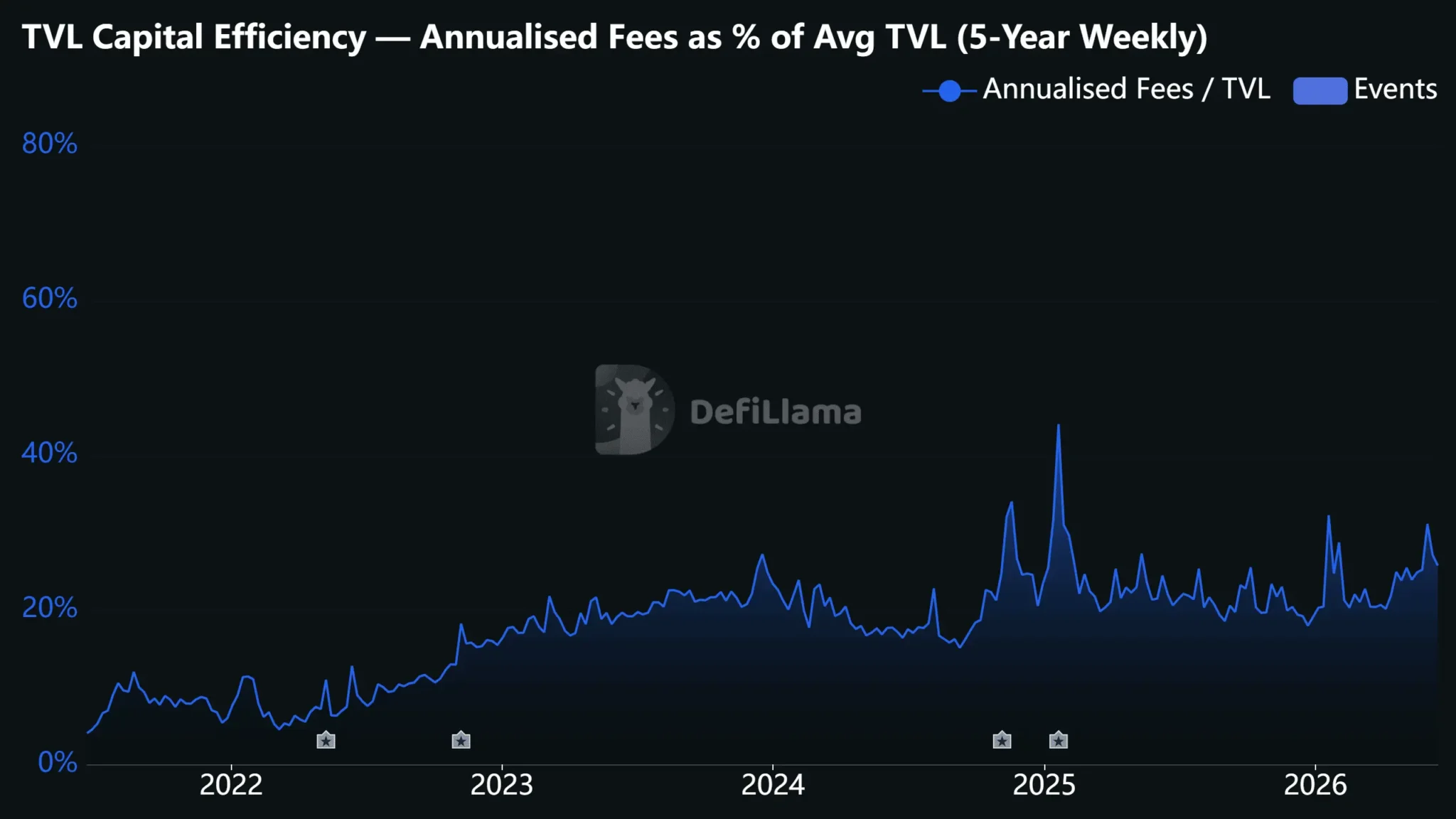
The second major catalyst in this report is the capital utilization metric. Historically, the success of a protocol was crudely measured by its TVL—a vanity metric that often hid millions of dollars parked without generating real yield. That changed this year.
The capital base locked in DeFi contracted by nearly half in tandem with general market conditions, but the remaining assets are working twice as hard. Annualized fees relative to TVL jumped from a modest 20% in January to a range between 25% and 30% recently. On-chain money is no longer sleeping; smart routing and concentrated liquidity pools optimize it, transforming platforms into much leaner, more efficient, and more profitable enterprises.
Toward a Sustainable Corporate Ecosystem
For the token price of governance tokens of the main DEXs, this paradigm shift is fundamental. As a higher fee rate per trade solidifies, treasury revenues become predictable and less dependent on the massive volume of bull markets.
In the medium term, this optimization paves the way for real institutional adoption. Traditional firms do not look for networks saturated with artificial volume; they look for efficient financial architectures where capital yields the maximum with the lowest possible risk of stagnation. DeFi proves it can shrink in nominal size without losing a single cent of its monetization capacity.
Disclaimer: The information presented is strictly for educational and informational purposes and should not be considered financial investment advice. Trading crypto assets and interacting with DeFi carry a high risk of capital loss.

Graphic design student. Illustrator. Exploring cryptography and blockchain, and creating NFTs.