
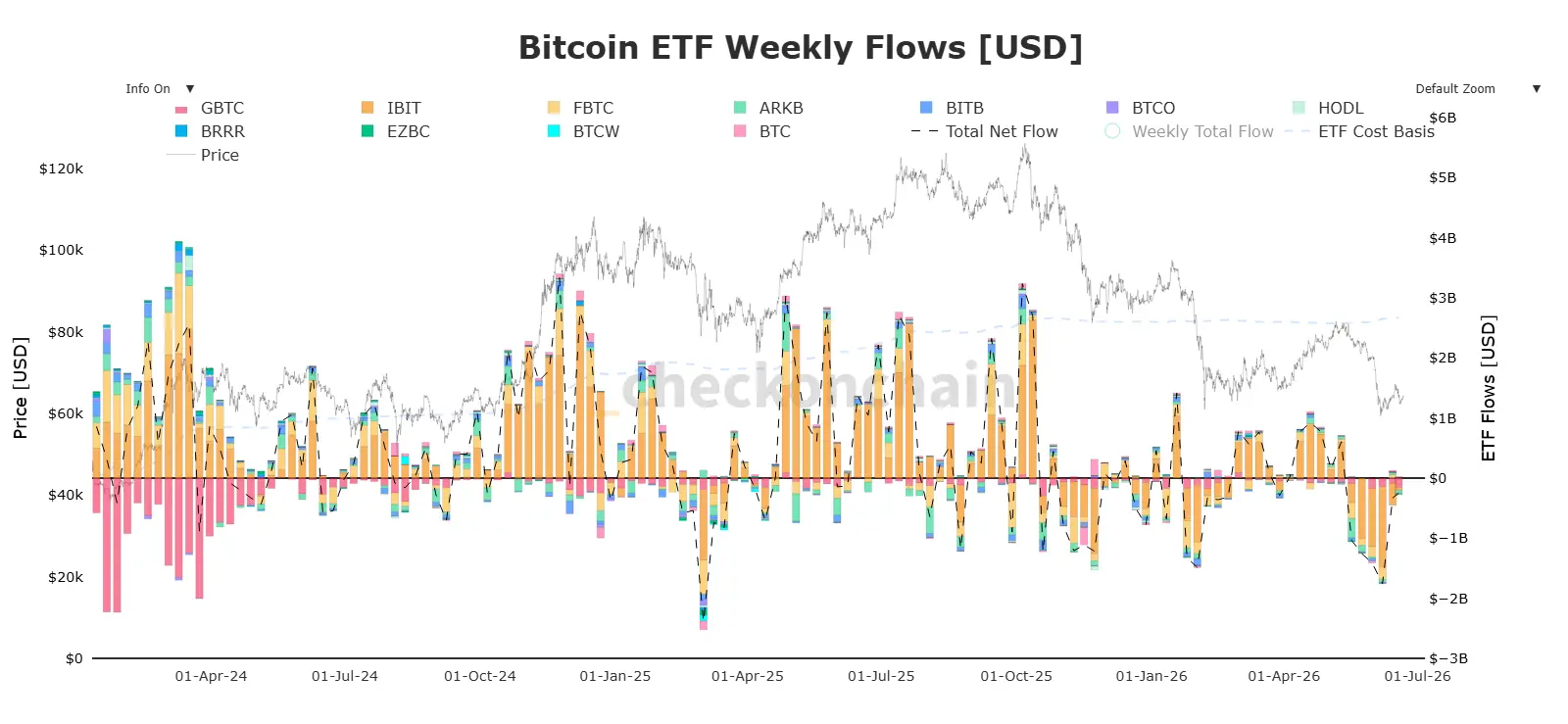
The institutional cryptocurrency market is sending stabilization signals following weeks of intense bearish pressure. During the week ending June 18, 2026, spot exchange-traded funds (ETFs) recorded a net capital outflow of -$253.3M, according to the latest data from analytics firm Checkonchain. Although this figure keeps the scoreboard in negative territory for the sixth consecutive week, it represents significant relief for the sector: it is the lowest negative flow recorded in the last month and a half, marking a notable deceleration compared to the -$326M that evaporated the previous week. This truce in institutional sentiment directly coincides with a cooling of global geopolitical tensions that were impacting inflation expectations.
The Hormuz Factor: Oil Gives Bitcoin a Breathing Room
The sharp deceleration in capital outflows from institutional financial vehicles did not occur in a macroeconomic vacuum. Analysts point out that the relief arrived after oil prices dropped to multi-month lows. This downward adjustment in the energy sector followed the US government’s announcement regarding the start of formal negotiations with Iran, seeking a peaceful and stable opening of the strategic Strait of Hormuz.
Since energy costs have been the primary driver of persistent global inflation during the first half of 2026, the possibility of a diplomatic agreement deflated fears of further interest rate hikes by the Federal Reserve. As a result, large investment funds halted their aggressive de-risking plans, stabilizing demand within the Bitcoin network.
ETF Radiography: Institutional Whales Trapped in Losses
This week’s on-chain data exposes the complex financial situation facing investors who entered the ecosystem through Wall Street. As of June 18, 2026, the trading price of bitcoin stood at $63,933, a figure that puts direct pressure on institutional portfolios when compared to the average purchase price of these funds.
Analysis of the institutional average cost basis reveals a stark reality: the ETF Cost Basis currently sits at $83,437. This means that, at the current market value, an overwhelming 87.32% of incoming capital flows are underwater (Inflow in Loss). In contrast, just a meager 12.68% of inflows remain in profitable territory (Inflow in Profit), corresponding mainly to pioneer investors who took positions in early 2024.
Market Outlook: Is the Institutional Bottom Approaching?
Despite the deep percentage of institutional portfolios in the red, the slowing pace of weekly divestment suggests that ETF capitulation might be bottoming out. Bitcoin’s resilience in holding the key support zone above $63,000, combined with the truce in global energy supply, reduces incentives for trading desks to continue liquidating their holdings at losses of nearly 24% relative to their cost basis. In the short and medium term, if diplomatic talks regarding the Strait of Hormuz progress and core inflation data continues to ease, we will highly likely see the return of positive capital inflows into ETFs, driving a reaccumulation phase before the end of the quarter.
Disclaimer: This analysis is strictly informative and journalistic. It does not constitute financial or investment advice, nor an offer to buy or sell digital assets. Cryptocurrencies are highly volatile assets.

Communications Professional. Crypto Enthusiast. Economic Journalist. Bitcoiner & Altcoiner.