
The cryptocurrency market is preparing for a crucial stress test, according to the latest report from Tokenomist. Over the coming week, scheduled token unlocks are projected to exceed $730M in total value, a figure that promises to shake up liquidity across multiple ecosystems. Among the projects facing the heaviest supply pressure are Humanity Protocol ($H) and Newton Protocol ($NEWT), two radical case studies on how asset issuance can reshape a token’s price action in a matter of hours. Meanwhile, decentralized finance (DeFi) giants like Aster and Jupiter are taking the opposite path, deploying aggressive buyback and burn strategies to counteract dilution.
The Humanity Protocol Dilemma: $55M Put to the Test After Exploit
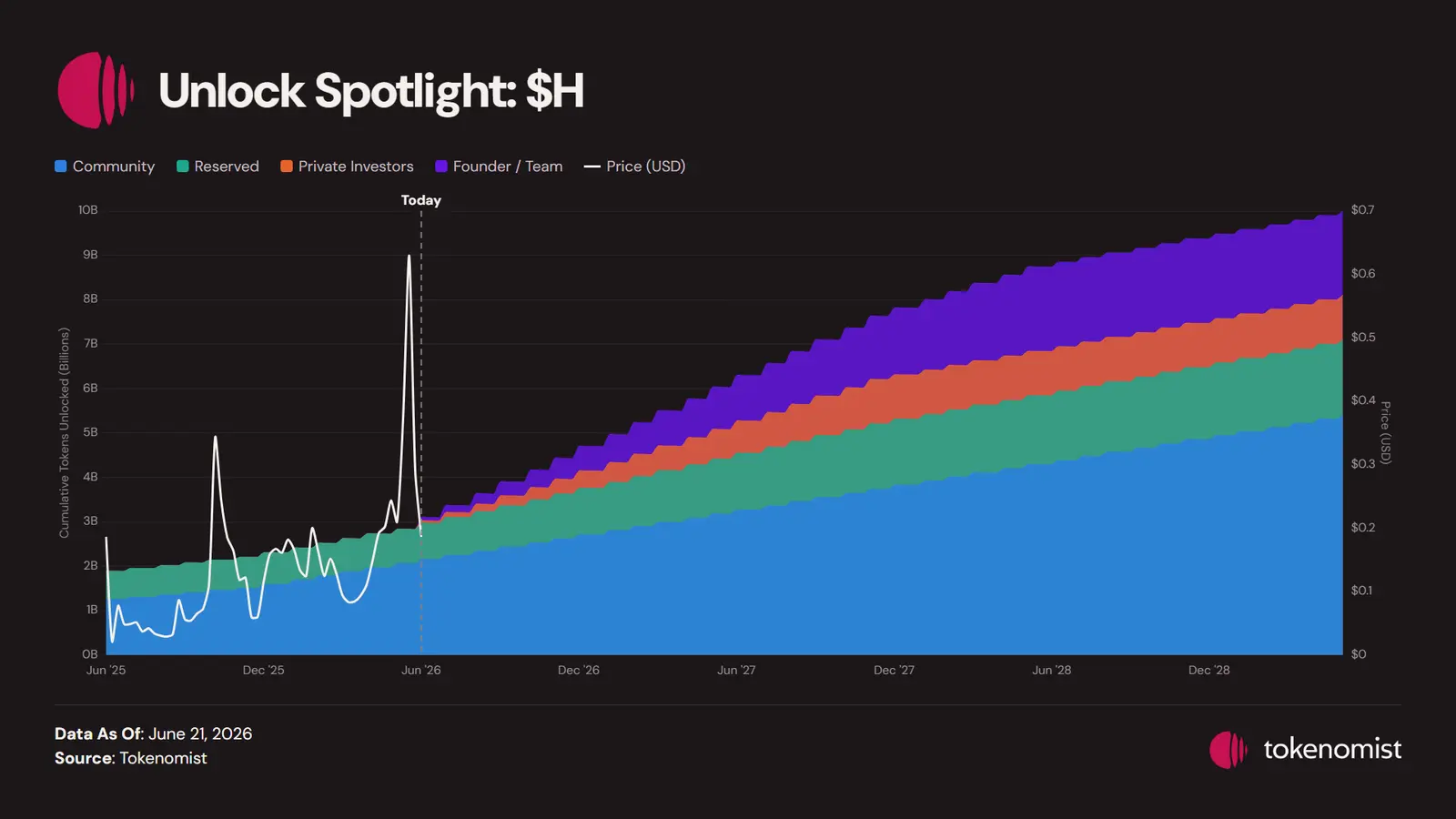
The main event of the week arrives on June 25, 2026, with Humanity Protocol ($H). The project will unlock $55M in tokens, equivalent to 9.4% of its circulating supply. The vested allocations span from early investors and contributors to the ecosystem fund and the Human Institute’s strategic reserve.
However, the context could not be more complex. This massive unlock occurs just two weeks after a private key vulnerability (suffered between June 8 and June 9) caused losses exceeding $30M. The incident forced the team to migrate to a new smart contract, leaving the price of $H trading near $0.19, well below its highs from earlier this month.
To mitigate the disaster, the Humanity Foundation took a hardline measure: they required over 100 investors to choose between accepting a 70% haircut (discount) for an immediate release or extending their vesting period for three years. This crossroads reduces market predictability: if the majority chooses to wait, actual selling pressure will be significantly lower than the projected $55M. If they decide to liquidate, the token will face a harsh supply overhang.
Newton Protocol and the 64% Threat: Low Liquidity, High Risk
The scenario for Newton Protocol ($NEWT) on June 24, 2026, is the flip side of the coin. Although the absolute value of the unlock is just $7.5M, the figure represents a colossal 64% of its circulating supply.
When an unlock accounts for more than half of the current circulating supply, market structure shifts completely. Dilution risk is at its peak.
The tokens will primarily flow to core contributors and seed backers, a highly concentrated group. $NEWT is already trading close to its all-time low of $0.053—a 90% plunge from its all-time high of $0.83 in June 2025. While $7.5M might seem minor for the global market, it is a dominant factor for $NEWT’s internal liquidity that could sink its price action even further if beneficiaries decide to take profits.
The DeFi Counteroffensive: Aster and Jupiter Bet on Deflation
Faced with a flood of new tokens entering circulation, other protocols are rewriting their tokenomics to defend the value of their assets.
Aster’s ($ASTER) “198%” Model
Decentralized exchange Aster implemented an aggressive restructuring on June 17. The protocol now directs 99% of daily platform fees to automated buybacks using a TWAP (Time-Weighted Average Price) strategy for users staking veASTER. By pairing this with equivalent burns (a mechanism marketed as a “198% buyback and burn”), Aster targets an extreme deflationary path: reducing its total supply from 7.82 billion to just 3 billion tokens.
Jupiter ($JUP) Follows in Hyperliquid’s Footsteps
For its part, the Jupiter community is evaluating a governance proposal to increase the diversion of fees toward its Litterbox buyback mechanism, shifting from 50% to 70%. The explicit goal is to remove $JUP from the market to strengthen scarcity, emulating Hyperliquid’s successful revenue-driven model. Although the vote is still pending, the trend is clear: major DeFi players are looking to protect themselves from dilution through organic revenue.
A High-Tension Week
The collision of massive token unlocks diluting supply with the implementation of extreme deflationary policies in the DeFi sector proves that the crypto market is maturing through trial by fire. While investors in $H and $NEWT must trade with extreme caution ahead of imminent selling pressure, the accumulation narratives in $ASTER and $JUP point to where smart money is heading: targeting projects with real cash flows capable of absorbing their own tokens.
Disclaimer: The information presented in this article does not constitute financial advice. Crypto asset investments carry high risk due to inherent market volatility.

Graphic design student. Illustrator. Exploring cryptography and blockchain, and creating NFTs.