
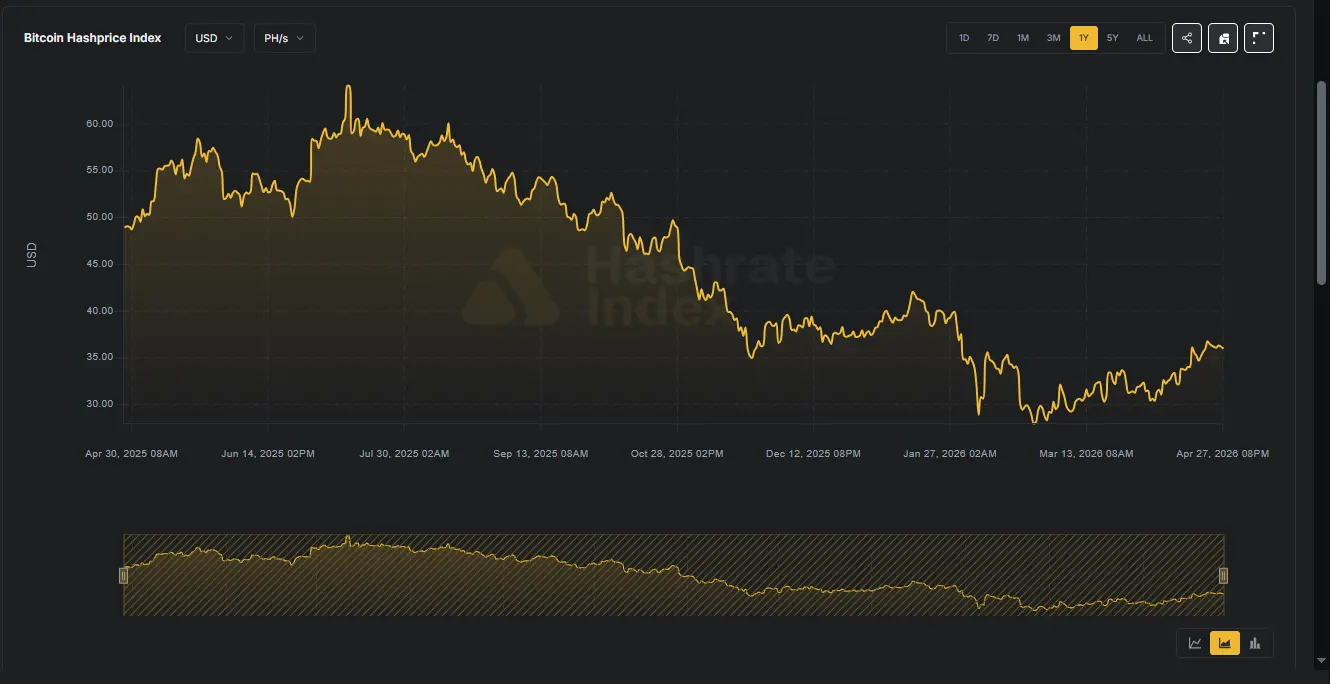
The Bitcoin mining ecosystem is navigating a period of key technical volatility. After hitting a local high of $36.92 per PH/s/day on April 22—driven by bitcoin prices nearing $79,500—Hashprice began a slight descent to its current level of $35.39. This movement reflects the constant battle between market price and increasing network difficulty, setting a frantic pace for mining farms striving to stay afloat in 2026.
The Profitability Thermometer: Understanding Hashprice
For the average investor, bitcoin’s price is the king metric; but for the miner, Hashprice is the air they breathe. This index, popularized by Luxor, measures the expected value of a specific amount of computing power (1 TH/s or 1 PH/s) per day.
Basically, it is a formula that combines four ingredients:
Bitcoin Price: The higher the price, the more the reward is worth.
Network Difficulty: More competition means less income per miner.
Block Subsidy: The fixed amount of BTC issued.
Transaction Fees: The “extra” users pay for priority.
April X-Ray: From Optimism to Adjustment
Hashprice behavior so far this year has been a rollercoaster. Coming off an annual high of $64.03, the industry took a hard hit in the first quarter, reaching an annual low of $30.31 in April.
However, bitcoin’s resilience—holding firmly above $60,000—allowed for a notable recovery. On April 22, as the asset reached $79,500, Hashprice climbed to $36.92. Nevertheless, as of this report on April 28, the figure retreated to $35.39. This reflects that while the asset price remains high, competition on the Bitcoin network (total hashrate) is exerting downward pressure on profit margins.
What Does This Mean for Miners?
When Hashprice rises, we are in “bonanza season.” Older, less efficient machines become profitable again, and large mining firms watch their cash flows soar, allowing them to expand operations.
Conversely, a drop in Hashprice (like the one seen since April 26) produces a “purge effect”:
Capitulation: Miners with high electricity costs must shut down their machines because they spend more on energy than they generate in bitcoin.
Asset Sales: To cover operating expenses (OPEX), many find themselves forced to sell their BTC reserves, which can create selling pressure in the market.
Consolidation: Large corporations with next-gen hardware take the opportunity to absorb the market share of smaller miners.
Market Outlook
Despite being far from the $40.15 recorded in January 2026, the fact that Hashprice remains above $35 is a sign of relative health, provided bitcoin does not lose the $70,000 support level. The ecosystem is in a delicate balance: Bitcoin technology is more robust than ever, but energy efficiency is now the only path to survival.
Disclaimer: This report is for informational purposes and does not constitute financial advice. Mining and investing in crypto assets involve significant risks.

Communications Professional. Crypto Enthusiast. Economic Journalist. Bitcoiner & Altcoiner.