
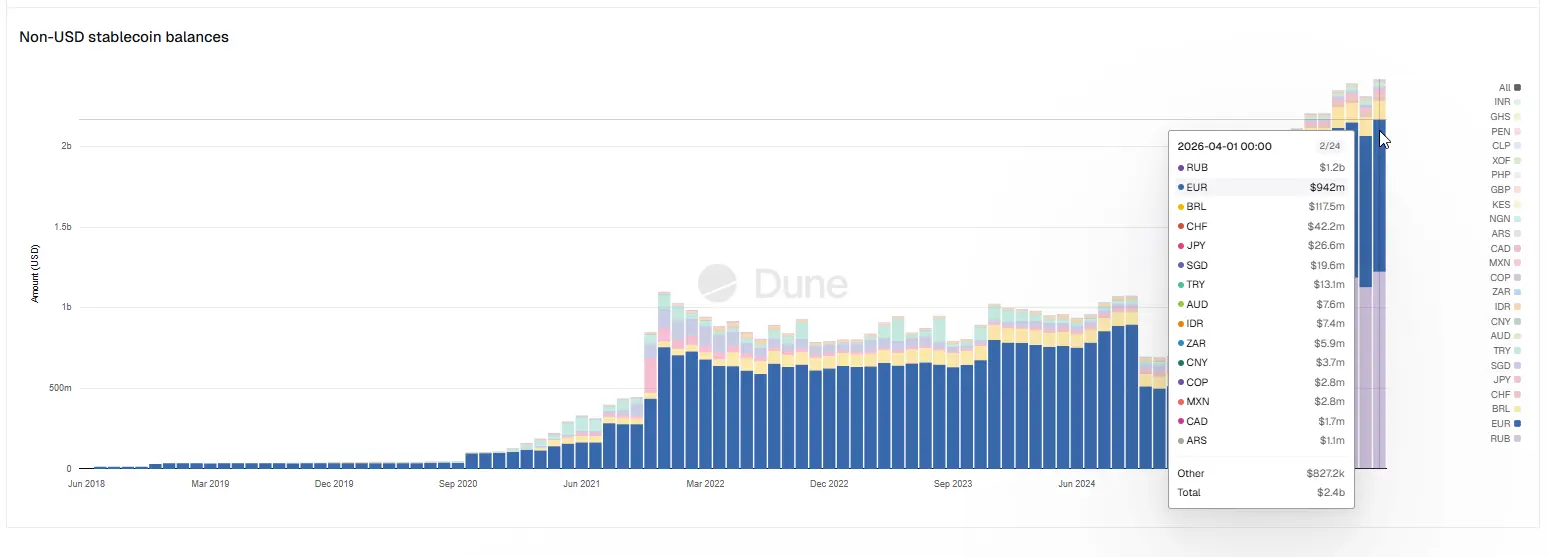
The stablecoin market is no longer an exclusive U.S. dollar club. According to real-time data from Dune Analytics, while $USD maintains a 99% dominance, a new battlefront is opening: non-dollar-pegged stablecoins have climbed to $2.4B. This growth, led by the euro (EUR) and the ruble (RUB), marks the beginning of an era where regional companies prefer to settle operations in their tokenized local currency to avoid exchange rate risk.
The Euro (EUR) and the Ruble (RUB): The New Protagonists
Balance sheet analysis reveals a surprising figure for the close of Q1 2026:
RUB (Tokenized Ruble): Positions itself as the leading non-$USD currency with $1.2B in circulation. This phenomenon largely responds to the need for alternative payment channels in emerging markets and areas with financial restrictions.
EUR (Tokenized Euro): With $942M, the euro is experiencing its best moment on the blockchain. The full implementation of the MiCA regulation in the European Union provided the legal certainty necessary for issuers like Circle (with EURC) and other European banks to inject institutional liquidity.
“Real World” Tokenization Reaches Latin America and Asia
The report also highlights the rise of emerging market currencies, which are finding bitcoin and Layer 2 (L2) networks to be the perfect rails for their operations:
BRL (Brazilian Real): With $117.5M, Brazil leads adoption in LATAM, driven by crypto-friendly regulation and a massive digital payments culture.
SGD (Singapore Dollar): With $19.6M, it consolidates its position as the liquidity hub for Southeast Asia, primarily used in international trade finance (TradeFi) protocols.
Why Are Companies Abandoning “Dollar Only”?
The narrative is shifting. For an exporter in Europe or a freelancer in Brazil, receiving $USD implies a double commission: from the blockchain to dollars, and from dollars to their local currency. The availability of tokenized EUR, BRL, or JPY allows for:
Direct Settlement: Instant 24/7 payments without going through correspondent banks.
FX Efficiency: A drastic reduction in foreign exchange spreads.
Local Compliance: Greater ease in tax reporting and meeting local treasury regulations.
The Short-Term Impact
As these “exotic” currencies (in a crypto context) gain volume, we expect to see a deeper integration of traditional finance (TradFi) with decentralized finance (DeFi). While bitcoin will remain the global store of value, tokenized fiat will be the bridge connecting the daily operations of real economies with blockchain efficiency.
Disclaimer: This analysis is for informational purposes and does not constitute financial advice. Investing in digital assets of any currency carries volatility and regulatory risks.

Communications Professional. Crypto Enthusiast. Economic Journalist. Bitcoiner & Altcoiner.