
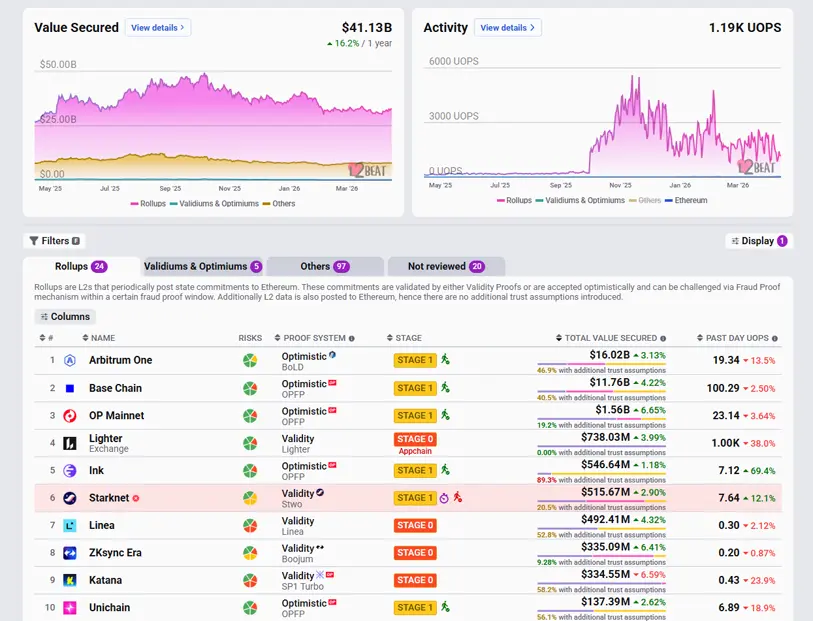
The Ethereum Layer 2 (L2) ecosystem solidified its technical and financial maturity by reaching a Total Value Locked (TVL) of $41.13B, representing 16.2% annual growth. According to the latest data from L2BEAT, this increase isn’t just a nominal figure; it reflects a massive liquidity migration toward faster, cheaper networks. Giants like Arbitrum and Base lead a race that is redefining how we interact with the Ethereum protocol.
Arbitrum and Base: The Undisputed Kings of the Sector
The L2 market has become a clash of titans where efficiency rules. Arbitrum One maintains the lead with impressive dominance, securing $16.02B of the total capital. However, all eyes are on Base Chain, the Coinbase-backed network, which now holds $11.76B.
The key takeaway for retail investors is the activity volume: while Arbitrum processes 19.34 UOPS (user operations per second), Base activity skyrocketed to 100.29 UOPS. This proves that decentralized application (dApp) adoption and retail trading are finding a permanent home on Base’s infrastructure.
The Battle of Architectures: Optimistic vs. ZK-Rollups
This technical report reveals a fascinating split in the technology backing these funds:
Optimistic Rollups: They continue to dominate TVL due to their immediate EVM (Ethereum Virtual Machine) compatibility. Networks like OP Mainnet ($1.56B) and the emerging Ink ($546M) utilize this technology.
ZK-Rollups (Validity Proofs): Although they hold lower TVL, they represent the long-term bet due to their mathematical security. Starknet ($515.67M) and zkSync Era ($335.09M) lead this segment, promising near-instant transaction finality that bitcoin cannot yet replicate on its base layer.
What Does This Mean for Asset Prices?
This 16.2% growth in value locked suggests “silent accumulation.” As more users lock their funds in L2s to participate in DeFi, selling pressure on bitcoin and, specifically, ether (ETH) on exchanges tends to decrease.
The emergence of specialized networks like Lighter (focused on exchanges) clocking 1.00K UOPS indicates that high-frequency trading is definitively moving from centralized platforms to the transparency of the blockchain.
An Ecosystem That Never Stops Scaling
We are witnessing Ethereum’s “execution phase.” With over 24 active projects and technological variations ranging from Stage 0 to Stage 2 decentralization, the L2 ecosystem is no longer an experiment; it is the backbone of the new digital economy. Liquidity flows toward efficiency, and today, that efficiency has specific names: Arbitrum, Base, and Rollup technology.
Disclaimer: This analysis is for informational purposes and does not constitute financial advice. Crypto-asset investments carry high risk.

Communications Professional. Crypto Enthusiast. Economic Journalist. Bitcoiner & Altcoiner.