
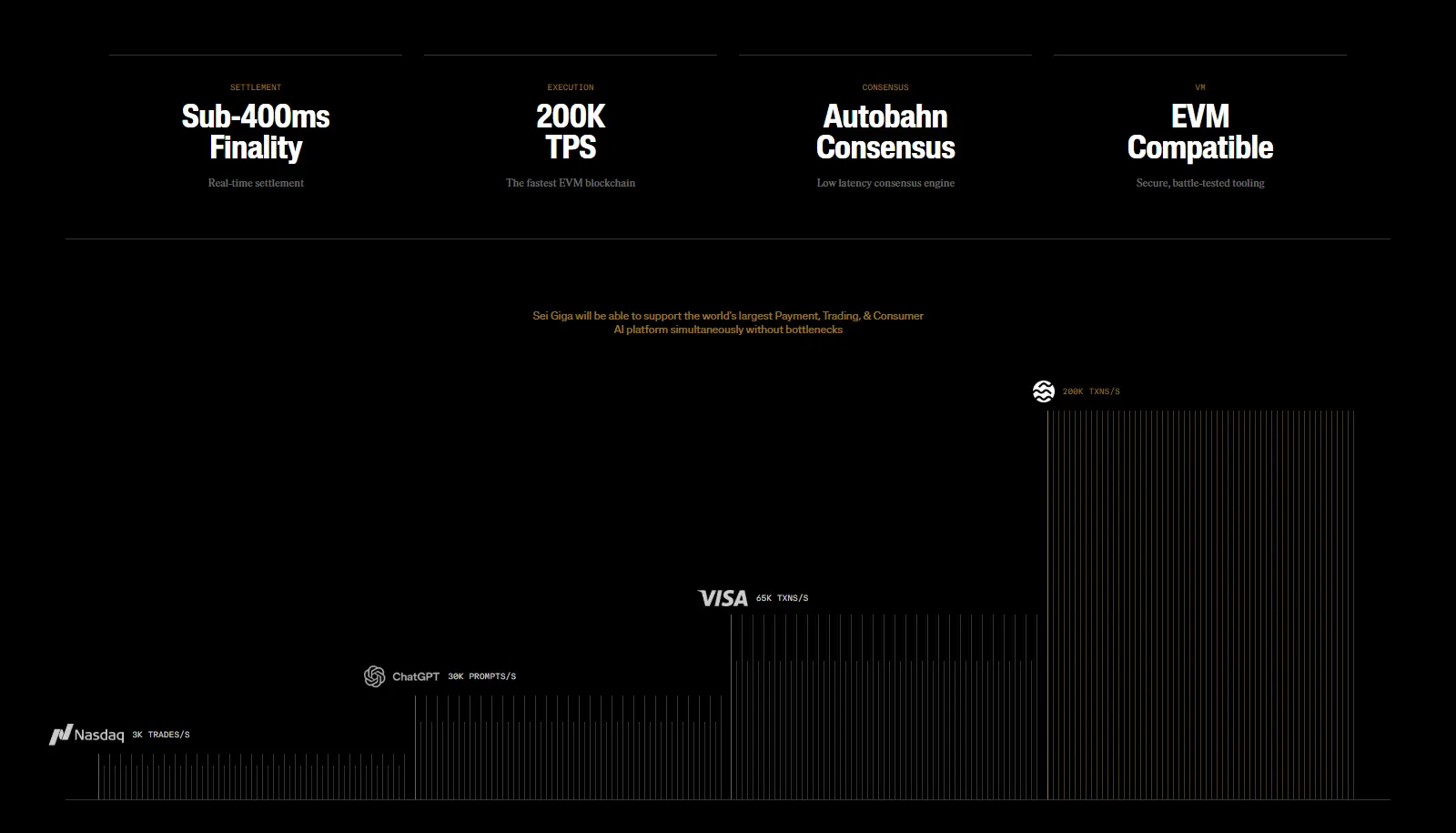
Sei Labs shakes up the crypto ecosystem by officially publishing the Sei Giga whitepaper, a massive structural upgrade designed to turn its network into the first Layer 1 (L1) blockchain with an Ethereum-compatible environment (EVM) that uses a multi-proposer system. With this innovation, Sei Giga aims to fundamentally solve traditional block processing bottlenecks, promising a massive speed of 200,000 transactions per second (TPS). This technical leap is not just theory: it arrives alongside a drastic operational ultimatum for exchanges and custodians, who have until June 15, 2026, to migrate their funds or risk losing access to the assets.
The End of Bottlenecks: How Does Sei Giga Work?
The major obsession of current L1 networks is scaling the Ethereum environment without losing decentralization. To achieve this, Sei Giga implements the Autobahn consensus protocol, an architecture that allows parallel block proposals (multi-proposer), destroying the classic bottleneck where a single validator slows down the entire queue.
Unlike other networks that copy traditional Ethereum execution clients like geth or reth, Sei Giga’s technology rebuilt its EVM client completely from scratch. This translates to 40 times higher execution efficiency and 70 times faster block production.
Metrics Scaring the Competition:
Wild Throughput: 5 gigagas of processing throughput capacity.
Record Speed: Estimated 200,000+ TPS for high-demand applications.
Near-Instant Finality: Transaction confirmation in less than 400 milliseconds (sub-400ms).
Asynchronous State Commitments: Network state generation processes outside the critical consensus path, freeing up space for more transactions.
Forced Unification: The Ultimatum for Exchanges Before June 15, 2026
Parallel to this display of technical brute force, the network is completing its definitive transition toward an exclusive, unified EVM architecture. This means that support for the Cosmos ecosystem (native addresses starting with sei1…) and IBC will be completely deprecated.
For users and trading platforms, this is a critical matter. Many exchanges managed native “Sei” and “Sei EVM” as two separate chains in their internal systems. The reality is that they are the exact same blockchain, and each public key mathematically maps to a single 0x… EVM address.
If trading platforms and custodians do not consolidate their wallets before June 15, 2026, the consequences will be severe: native Cosmos transaction interfaces will stop working, and funds trapped in unlinked sei1… addresses will become completely inaccessible.
Market Analysis: What Does This Mean for the Token Price?
Despite the technological rollout funded by giants like Jump Crypto, Coinbase Ventures, and Multicoin Capital (accumulating over $30M in investment rounds), the digital asset market remains cautious. Currently, the native token trades around $0.06, suffering from the pressure of an aggressive monthly unlock schedule that dilutes the circulating supply.
In the short and medium term, the success of Sei Giga will depend on developers leveraging these 5 gigagas of throughput to build financial or mass-consumer applications that generate real fees and active token burning. The forced exchange migration to the 0x… standard will clear technical friction, but the true litmus test will be seeing if this super-highway manages to fill up with traffic in an industry saturated with competitive L1 networks.
Disclaimer: This article is for informational purposes only and does not constitute financial advice, an investment recommendation, or an offer to trade digital assets. Cryptocurrency markets are highly volatile; conduct your own research before risking capital.

Graphic design student. Illustrator. Exploring cryptography and blockchain, and creating NFTs.