
The crypto market is sending mixed signals that only the most astute investors can decipher. While the price of Ether experiences downward corrections on short-term charts, Ethereum’s institutional staking ecosystem is living through one of its golden eras. Recent data from Staking Rewards proves that large firms and financial institutions are not selling; on the contrary, they are capitalizing on discounted prices to massively lock up their funds in validation contracts, prioritizing on-chain yields and network security over daily asset volatility.
Price Retraces, but Net Staking Flow Breaks Records
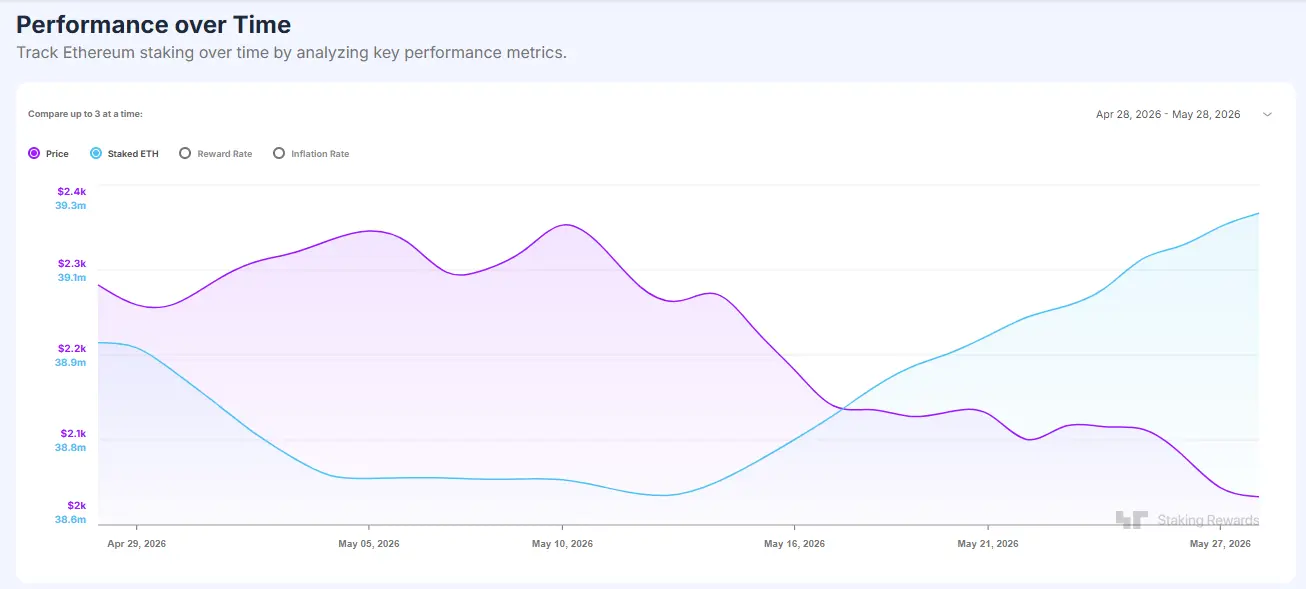
Recent data from Staking Rewards reveals a textbook structural bullish divergence. Over the past 30 days, the cryptocurrency’s price decreased by 10.54%, landing in the $2.02k range. In a conventional retail market, this would have triggered widespread panic. However, in high-finance circles, the story is radically different.
The Net Staking Flow chart shows that May has been a month of aggressive accumulation. In total, a net increase of 289.9k ETH was deposited into staking contracts, translating to a direct capital injection of $585m into the core of the protocol at current market values. This persistent bullish trend reflects that institutional whales are looking to generate predictable cash flows rather than speculating on immediate exchange prices.
Key Metrics: Maximum Security and Locked Value
The network’s resilience transcends traditional market sentiment. When examining performance over time through consolidated metrics, three factors validate the maturity of this ecosystem:
All-Time High Staking Rate: The total percentage of Ether’s circulating supply locked in validation nodes climbed to 32.53%, marking a 0.25% growth over the last seven days.
Staking Market Capitalization: The total value of assets securing the network reaches an impressive $78.10b, consolidating this mechanism as the largest decentralized security ecosystem in the crypto world.
Stable Annualized Rewards: With an average Annual Percentage Yield (APY) of 2.74%, the network distributes approximately $2B in rewards annually to validators, competing directly with traditional fixed-income yields but within a native digital environment.
Just like in the bitcoin market, where institutional investors prefer to accumulate the asset for the long term through regulated vehicles, the current priority for Ethereum is securing real yields against global inflation.
What Does This Mean for Mid-Term Price Action?
When nearly a third of a cryptocurrency’s entire circulating supply is locked in staking contracts and unavailable for sale on exchanges, it creates a macroeconomic phenomenon known as a supply shock.
In the short term, the network’s inflation rate remains tightly controlled at just 0.78%. If the institutional deposit flow maintains this upward trajectory, any spike in global demand during the second half of the year could trigger violent upward pressure on the spot price, as very few tokens will be available in the market to fill buy orders.
Disclaimer: This article is published solely for informational and educational purposes. It does not constitute financial advice, investment recommendations, or an invitation to trade digital assets. Cryptoassets carry high volatility and the risk of capital loss.

Communications Professional. Crypto Enthusiast. Economic Journalist. Bitcoiner & Altcoiner.