
Institutional capital decided to retreat in the face of global macroeconomic uncertainty. During the last five business days reported up to May 21, 2026, the crypto ETF market recorded a massive capital outflow that drained a total of -$1,366,663,578. This financial exodus was driven by escalating tensions in the Persian Gulf, specifically in the Strait of Hormuz, a critical chokepoint for global oil trade. Fears that high crude prices could act as an inflationary catalyst in the United States forced Wall Street funds to adopt a risk-off stance, pulling liquidity from exchange-traded funds to seek refuge in traditional assets and temporarily strengthening the US dollar.
The Macroeconomic Storm: Oil, Inflation, and the Fed’s Crossroads
The behavior of institutional investors is not random; it responds to a direct correlation with energy markets and Federal Reserve (Fed) policies. At the beginning of last week, the conflict in the Persian Gulf sounded alarms. With the crisis in the Strait of Hormuz keeping oil prices at elevated levels, the latent threat of an inflationary spike triggered alerts on the dashboards of major investment funds.
Given this outlook, expectations for the Fed to implement a rate cut vanished. The latest data from CME Group reveals that for the upcoming meeting on June 17, 2026, the market is pricing in that interest rates will remain frozen at 3.75%. Even worse, traders are already betting on a rate hike toward 4% by December of this year. A restrictive monetary policy for a longer period makes credit more expensive, strengthens the US dollar, and drastically weakens the appetite for risk assets like the crypto ecosystem.
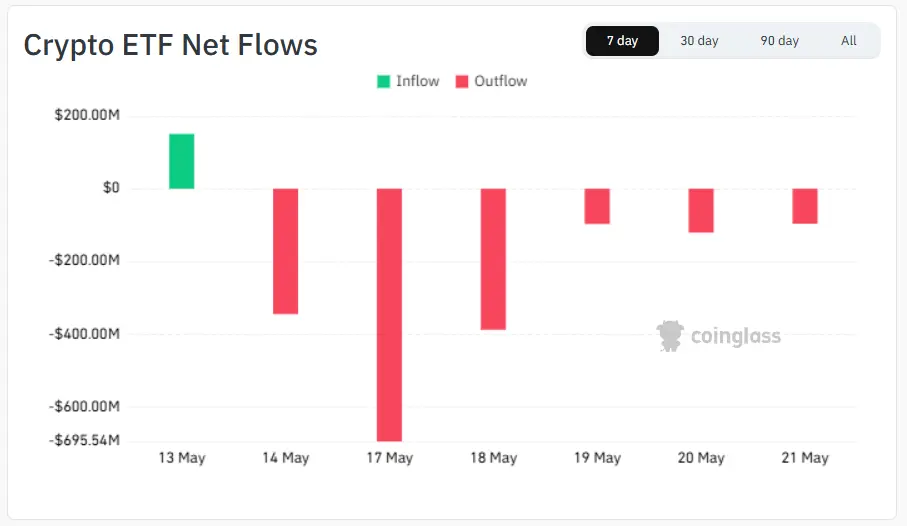
The daily evolution of the capital exodus reflects the magnitude of the impact on crypto ETFs:
- 05/17/2026: $-732.15M (Peak of geopolitical panic)
- 05/18/2026: $-388.12M
- 05/19/2026: $-97.15M
- 05/20/2026: $-120.72M
- 05/21/2026: $-96.53M
Despite the magnitude of the correction—which pushed monthly outflows to -$1,631,690,274—institutional infrastructure demonstrates remarkable resilience. The 31 active crypto ETFs, managed by 11 tier-one issuing firms, managed to retain total assets under management (AUM) of $122,011,190,400. This proves that big strategic capital maintains its long-term structural positions despite spot market turbulence.
The Corporate Landscape: Bitcoin and Ethereum Suffer Portfolio Rebalancing
The two highest-market-cap assets concentrated the heaviest selling pressure. Funds linked to bitcoin recorded daily net outflows of -$105,200,000. The primary corporate trigger was BlackRock’s IBIT (iShares Bitcoin Trust), which experienced a negative balance of -$68,900,000 in a single session. This move reflects the speed at which institutional treasuries liquidate liquid positions when facing geopolitical risks. Despite profit-taking, structured financial products built on the Bitcoin network continue to absolutely dominate the institutional landscape, safeguarding a total AUM of $96,910,200,000.
For their part, instruments backed by Ethereum followed the negative trend of exchange-traded funds with daily net outflows of -$6,600,000, maintaining managed assets of $21,854,100,000 across their 9 active ETFs. The correlation between both assets demonstrates that the high-interest-rate environment uniformly impacts large Layer 1 blockchain platforms.
Diplomacy to the Rescue: Outflow Deceleration and the Safe Haven in Altcoins
Not everything was capitulation on trading desks. Toward the close of the week, the brutal capital outflow began to show signs of exhaustion and deceleration. The key factor behind this relief was geopolitical: news broke regarding new diplomatic negotiation tables between the US and Iranian governments with the firm objective of ending the crisis in the Strait of Hormuz. This news partially dissipated fears in the energy market, pushing oil prices down over the last three sessions and removing selling pressure from the digital asset market.
This stabilization allowed for an interesting rotation of capital into niche assets and highly efficient alternative networks. While bitcoin suffered, Solana and XRP exchange-traded funds recorded positive balances with net inflows of +$5,800,000 and +$9,470,842, respectively.
However, the big surprise of the day came from the emerging sector. The Hyperliquid token (HYPE) channeled very positive institutional flows. Its flagship ETF, trading under the ticker BHYP, led the day’s performance by capturing a net injection of +$11,000,000. Although the Hyperliquid segment is still young on Wall Street, counting 2 active funds and an AUM of $80,600,000, its traction demonstrates that a faction of institutional investors prefers to take risks on high-yield decentralized financial protocols rather than completely withdrawing their liquidity from the crypto ecosystem.
Short-Term Market Outlook
The health of the institutional crypto asset market will directly depend on the success of diplomatic channels in the Persian Gulf and upcoming inflation reports in the United States. If talks between Washington and Tehran prosper and oil consolidates its downward trend, pressure on the Fed will decrease, opening a window of stability for market makers to restart their accumulation programs. The robustness of the more than $122B in consolidated AUM proves that the crypto ecosystem is no longer a peripheral market, but an integrated component in Wall Street’s global financial macro strategies.
Disclaimer: The information presented in this article is for purely informational and educational purposes. It does not constitute financial advice or investment recommendations. Digital assets carry a high risk of volatility and capital loss.

Communications Professional. Crypto Enthusiast. Economic Journalist. Bitcoiner & Altcoiner.