
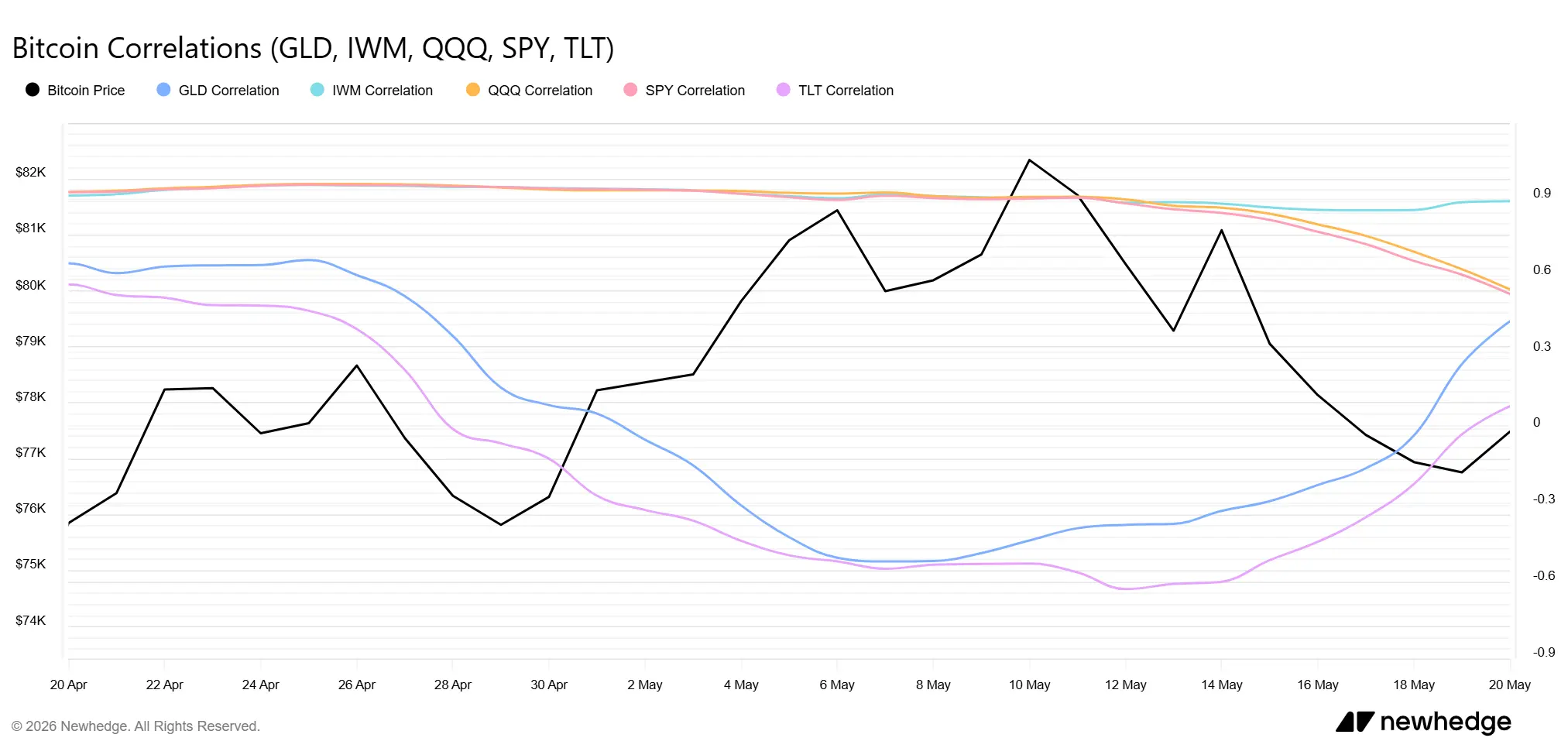
Over the past month, bitcoin showed remarkable structural maturity by disconnecting from Wall Street’s major tech and fixed-income indices. Macro data from the last 30 days reveals that while the bitcoin price advanced moderately to hit $77,488.00 on May 20, its historical correlation with mega-cap tech companies (QQQ) and the S&P 500 (SPY) collapsed by nearly half, opening a new chapter of independence for the digital asset.
The Tech Divorce: Bitcoin Cuts Ties with QQQ
For months, analysts treated bitcoin as a simple high-beta tech stock. In April 2026, the rolling 30-day correlation between the crypto asset and the Invesco QQQ ETF (QQQ) stood at a near-perfect 0.93. A reading of 1.0 means both assets move in exact synchronization.
However, by May 20, this metric suffered a dramatic collapse, dropping to 0.55. The same trend played out with the S&P 500 (SPY), whose correlation dropped from 0.93 to a moderate 0.53 over the same period. This decoupling from Wall Street suggests that capital flowing into the Bitcoin network is responding to internal blockchain dynamics and its own scarcity narrative, rather than simply following the mood of traditional equity markets.
Small Caps Remain Aligned
Interestingly, the Russell 2000—represented by the IWM ETF (IWM)—was the only index to maintain a strong link with the digital ecosystem. Its correlation barely shifted, moving from 0.91 in April to 0.89 in May.
This leaves us with an important market takeaway: bitcoin remains highly tied to risk-on appetite from more speculative capital and the global liquidity conditions that affect small-cap companies, temporarily moving away from the price action of mega-cap tech corporate giants.
Traditional Safe Havens vs. The New Digital Gold
On the safe-haven asset front, correlation with the SPDR Gold Shares ETF (GLD) fell from 0.65 to 0.42. This proves that while physical and digital gold share anti-inflationary narratives, their short-term accumulation cycles do not move to the same beat.
Long-term Treasury bonds via the TLT ETF (TLT) delivered the biggest surprise, with their correlation sinking from 0.57 to an insignificant 0.09. Bitcoin completely ignored traditional fixed-income fluctuations during this monthly cycle.
Market Outlook: Where Is Liquidity Heading?
The price action, which rose from $75,852.00 in April to $77,488.00 in May, combined with this decompression in macro correlations, signals a healthy trend for long-term investors. Historically, when bitcoin manages to decouple from traditional equity and bond markets, it gains the necessary autonomy to trigger parabolic bull runs driven purely by on-chain metrics, such as network hash rate or institutional wallet accumulation. For a millennial generation seeking true diversification, this emancipation from the traditional financial system could be the most anticipated catalyst of the year.
Disclaimer: The data analysis provided does not constitute financial advice. Crypto asset investments involve high capital risk.

Communications Professional. Crypto Enthusiast. Economic Journalist. Bitcoiner & Altcoiner.