
Blockchain infrastructure is about to take a major evolutionary leap. The Near One team announced the launch of Dynamic Resharding, a critical protocol upgrade scheduled for June 2026 as part of network version 2.13. This development will force Bitcoin, Ethereum, and other networks to watch from the sidelines as NEAR automatically splits its shards based on market demand. The upgrade eliminates human intervention and clears the path to process millions of AI agent transactions in real time. For investors, this milestone redefines horizontal scalability in Web3.
The Evolution Toward 70 Shards and 1 Million TPS
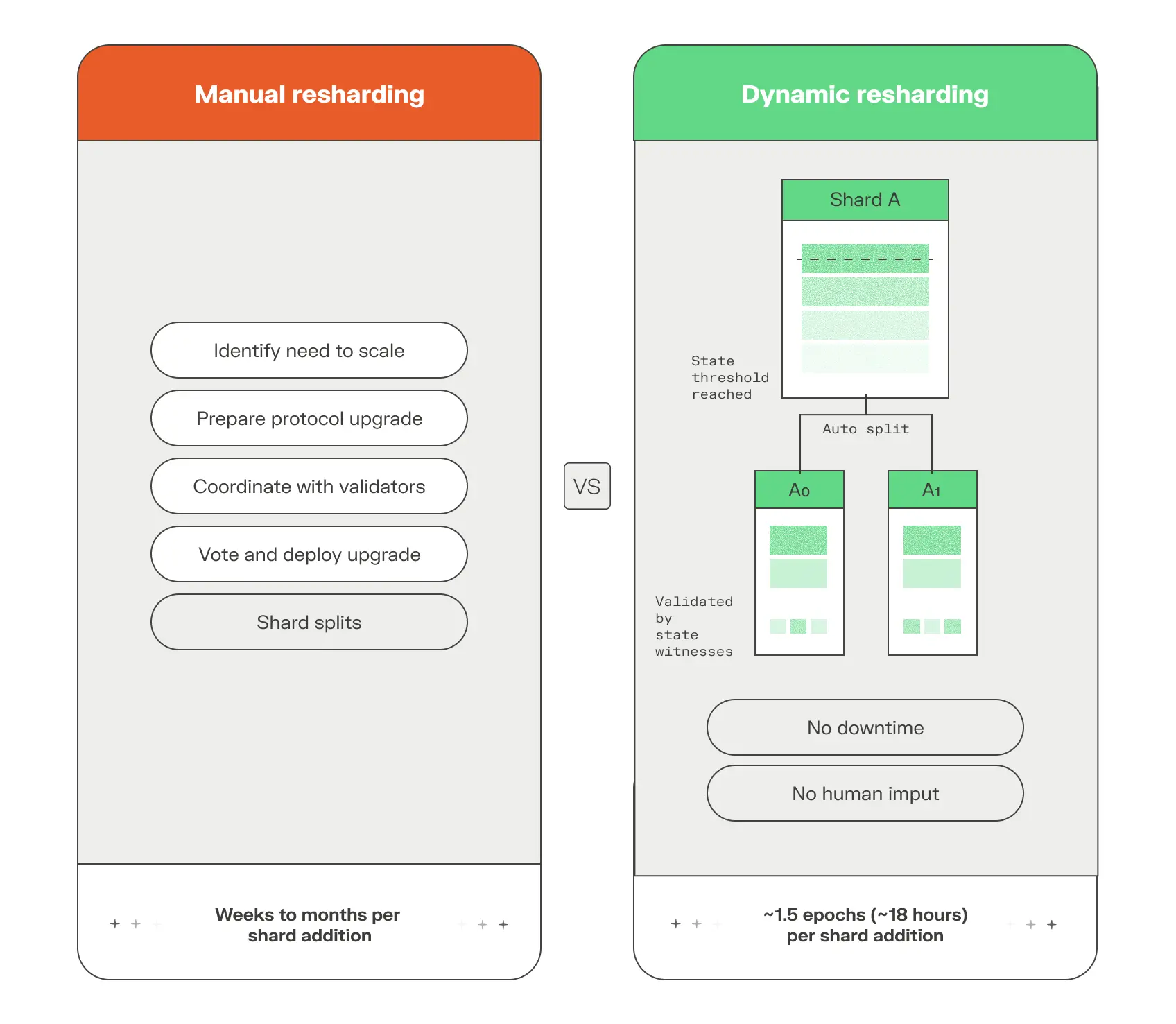
Since its mainnet launch in 2020, NEAR Protocol has tackled scalability through a multi-layered approach that is far from monolithic. After hitting historic milestones like stateless validation in 2024 and experimentally optimizing for 1 million transactions per second (TPS) in 2025, the network currently operates with 9 active shards. However, sharding still relied on manual processes and protocol upgrades coordinated with validators, which took between 1 and 2 months.
Dynamic sharding removes the human coordination bottleneck. The network will deterministically detect when a shard reaches its storage or performance limit and will automatically split it in approximately 1.5 epochs (a matter of hours).
Thanks to previous optimizations that reduced data overhead, NEAR can now efficiently scale to at least 70 shards without losing performance. This represents a 10x increase in current network capacity, far outpacing the processing volume of traditional giants like Visa.
Supporting the AI Agent Economy and NEAR Intents
The true fundamental value of this upgrade is commercial, not just technical. NEAR co-founder Illia Polosukhin projected that AI agents will execute the majority of global commerce in the future, translating into billions of automated transactions.
“Dynamic sharding is the missing piece to ensure NEAR acts as the global settlement layer for the AI agent economy, absorbing massive demand spikes without gas fees surging.”
The architecture already leverages sharded smart contracts (implemented in late 2025 via NEP-616), allowing the state of a single application or fungible token to spread across multiple shards. Key infrastructure like NEAR Intents and global wallet contracts are already deploying under this standard, ensuring the ecosystem grows without saturation risks.
Short- and Medium-Term Market Impact
The deployment of upgrade 2.13 in June 2026—which will also include a secure post-quantum signature scheme—positions NEAR as the most efficient Layer 1 protocol for AI and Web3 convergence. In the short term, automating dynamic sharding reduces network operational risk, attracting institutional developers. In the medium term, if the AI agent economy takes off, processing demand could significantly drive the utility and value of the native token, cementing it as an indispensable infrastructure asset in crypto portfolios.
Disclaimer: The information in this article is purely for educational and informational purposes and should under no circumstances be considered financial advice or investment recommendations. Digital assets are highly volatile; conduct your own research before risking capital.

Communications Professional. Crypto Enthusiast. Economic Journalist. Bitcoiner & Altcoiner.