
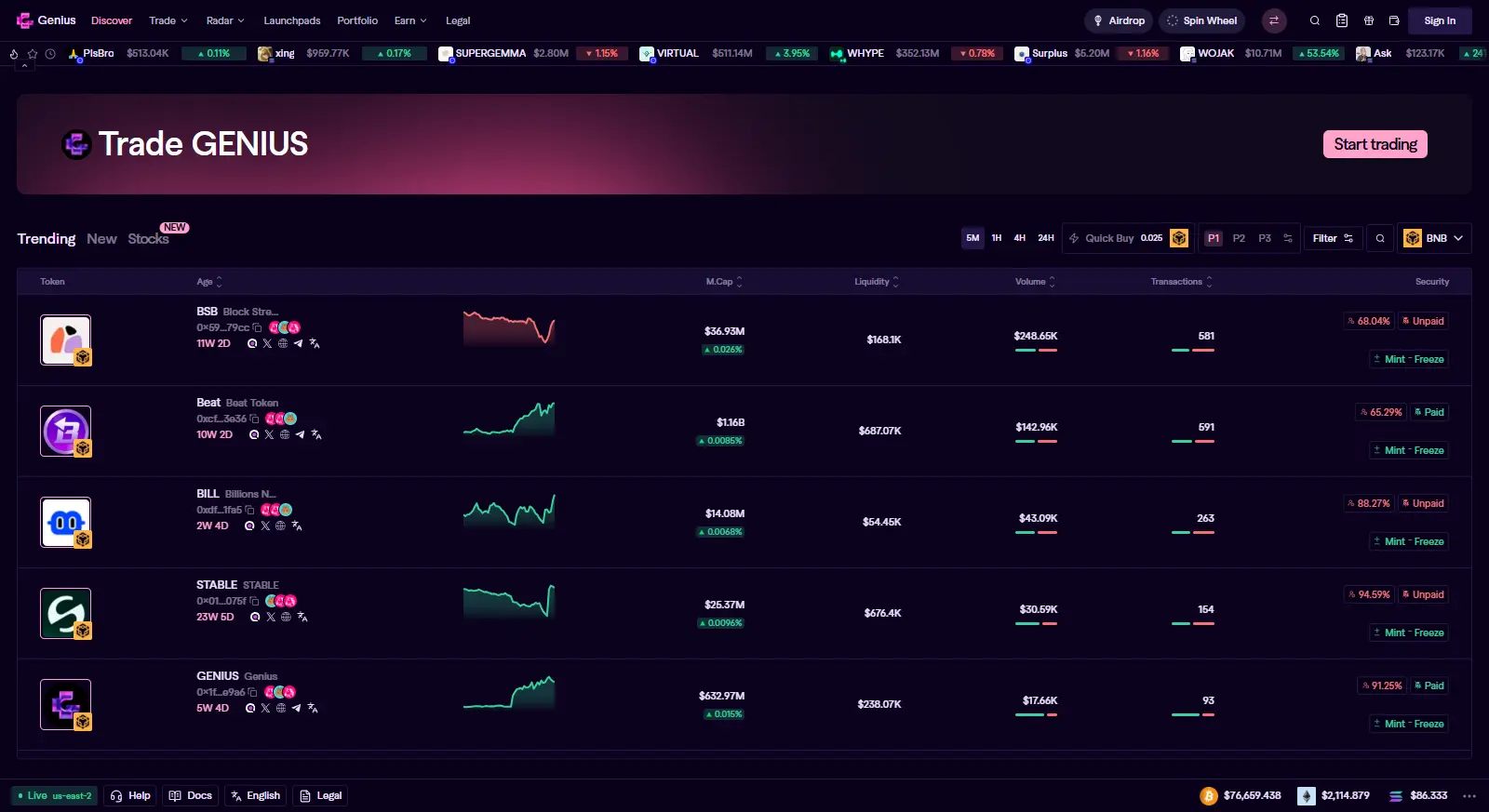
The decentralized finance (DeFi) ecosystem just received its biggest upgrade of the year. Binance, the world’s largest cryptocurrency exchange, officially announced the listing of Genius Terminal’s native token (GENIUS) on its spot trading platform. Following successful debuts on giants Kraken and KuCoin, this platform designed for professional traders aims to fundamentally solve Web3 liquidity fragmentation. It enables seamless trading with zero manual signatures and complete privacy across more than 300 decentralized exchanges (DEXs) spread across nine blockchain networks.
Conquering CEXs: From On-Chain Privacy to the Global Showcase
The Binance announcement marks a turning point for Genius Terminal (GENIUS). The exchange immediately opened deposits for the GENIUS/USDT, GENIUS/USDC, and GENIUS/TRY trading pairs, applying its Seed Tag for highly innovative and volatile projects. Additionally, the platform allocated a pool of 25,000,000 GENIUS tokens exclusively for future marketing campaigns, ensuring an aggressive community adoption strategy.
This listing is no isolated event. On May 15, Kraken enabled trading for the token, highlighting its ability to unify the execution typical of a centralized exchange (CEX) with DeFi self-custody. Meanwhile, KuCoin accompanied its integration with thousands of dollars in USDT giveaways to boost its market. Reaching the three centralized big leagues provides the project with the institutional liquidity it needs to back its ambitious technical infrastructure.
“Ghost Orders” and Chain Abstraction: The Arsenal for DeFi Sharks
For millennial audiences and digital-native traders, trading in DeFi has historically been a headache: switching networks, accepting endless wallet pop-ups, paying ghost fees, and suffering from front-running (bots that front-run your transactions). Genius Terminal arrives to retire that outdated user experience through an “invisible” architecture with zero constant signing.
Its main differentiator lies in Ghost Orders. Using Multi-Party Computation (MPC), the system algorithmically splits a single buy or sell order across up to 500 different wallets. The result? Tracking bots cannot link the execution back to the trader’s main wallet, eliminating the risk of unwanted copy-trading and protecting the moves of actual market whales. By unifying spot markets, perpetual futures (like Hyperliquid), and yield farms into a single dashboard, the platform transforms complex smart contract logic into a clean, ultra-fast interface.
Next Stop: Liquid Options on the BNB Chain
Expansion does not stop at traditional trading. The development team confirmed that test transactions are already running for the launch of G. OX (Genius Options Exchange). This component will become the most liquid short-term options market on the BNB Chain, allowing sophisticated users to execute high-speed financial hedges with direct settlement on the Binance blockchain.
Market Impact and Analytical Verdict
In the short term, adding Genius Terminal (GENIUS) to Binance order books typically triggers a positive liquidity shock, attracting both speculators and institutional investors seeking exposure to Web3 infrastructure tools. In the medium term, the true value driver for the GENIUS token will be the transaction volume the terminal processes. If the platform successfully consolidates itself as the definitive interface for professional capital, we could be witnessing the birth of the true operational standard for private trading in the decentralized era. The ecosystem no longer wants band-aids; it demands enterprise-grade, unified solutions.
Disclaimer: Investments in crypto assets and tokens with a Seed Tag carry a high risk of volatility due to their innovative technological nature. This article is strictly for informational and educational purposes and does not constitute investment or financial advice. Always do your own research (DYOR).

Communications Professional. Crypto Enthusiast. Economic Journalist. Bitcoiner & Altcoiner.