
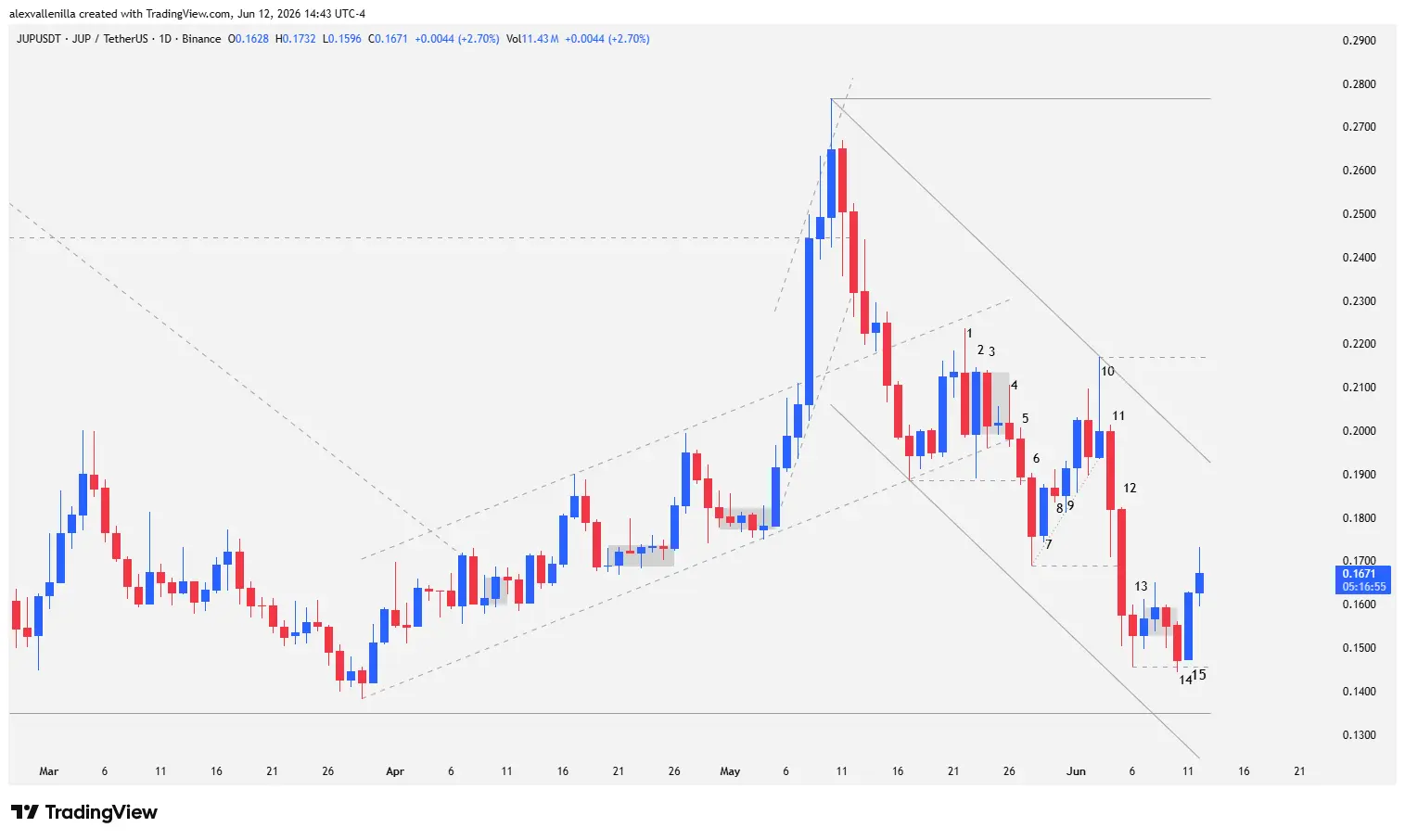
The Jupiter (JUP) cryptocurrency market faces a crucial battle on its daily (1D) chart, trading at $0.1672 in today’s session. After suffering an aggressive bull trap that culminated in a 34-bar bear channel, price action reveals supply exhaustion through a severe climactic capitulation. The recent formation of a double bottom pattern at the local support of $0.1457 injects optimism into traders looking to validate a bias shift against a dominant 802-bar macro bearish structure this year in 2026.
The Weight of the Macro Structure and the “Sell the Rally” Concept
To understand JUP‘s volatility, traders must evaluate the macro map. The asset carries a primary 259-bar downtrend that buyers managed to temporarily pierce via a “spike and channel” pattern. This technical move structured a 58-bar bull channel that, on its third acceleration push, successfully violated resistance at $0.2446—the last relevant lower high of the previous bear cycle.
However, euphoria faded when price triggered a bull trap at the $0.2766 resistance. The inability to sustain that level returned absolute control to supply. Professionals and the crypto ecosystem remember that all this action unfolds within a mammoth 802-bar major bearish structure. Under this environment, institutional algorithms systematically apply a sell the rally strategy, transforming every minor bounce into liquidity for their short positions. Today, JUP reflects this macroeconomic punishment: it accumulates a 64.26% loss over the last 12 months and an 11.58% contraction year-to-date in 2026, showing a mere 0.79% reaction in the last quarter.
Technical Analysis (Top Priority)
A detailed, bar-by-bar reading of order flow and crowd psychology reveals how control of the market shifted:
Bar 1: Bears set up a bearish outside bar. Although the low attempted to defend the previous 58-bar bull channel, the massive upper tail evidenced heavy rejection at the $0.2766 resistance zone. Smart money completely absorbed buy orders, forcing a lower close on the candle.
Bar 2: Volatility accelerates. Bears pierce the lower side of the bull channel and sweep buyers’ stop losses by breaking the low of the previous bullish signal bar. Although hidden buy orders absorbed supply at the lows, leaving a large lower wick and overlapping the body of Bar 1, price enters congestion. Its low acts as the structural anchor to project the floor of the new 34-bar bear channel and weakens key support at $0.1886.
Bar 3: Bears confirm a reversal failure, trapping traders who bought prematurely at the previous bar’s support.
Bar 4: Appears as a bearish closing pinbar. The bar pierces the 58-bar channel again and manages to close outside the previous range, breaking the congestion in favor of supply.
Bar 5: Formally breaks and invalidates the 58-bar bull channel. The low subtly pierces support at $0.1886, though demand prevents a close below it.
Bar 6: Confirms the loss of the control zone at $0.1886. This breakout validates the structure of the new downtrend and establishes local support at $0.1689.
Bar 7: Represents a bullish inside bar with an extremely narrow range relative to the 20-period average. Lacking volume, it does not qualify as an institutional entry, but it temporarily halts the price cascade by keeping its low above Bar 6.
Bar 8: Registers a very small-bodied bearish pullback attempt that quickly fails under buying pressure.
Bar 9: Small bullish bar confirming the failure of Bar 8 by closing above its high. This triggers a bullish microchannel (short-term countertrend) within the main 34-bar bear channel.
Bar 10: Bulls push price higher, marking short-term higher highs, but fail to exceed the high of Bar 1, setting up a critical lower high. The move ends as a bullish closing pinbar with an upper tail substantially larger than its body. This high anchors the 34-bar downtrend line and fixes local resistance at $0.2169.
Bar 11: Executes a pullback that fractures the 6-bar bull microchannel by closing below the low of Bar 10, though it fails to test support at Bar 6.
Bar 12: An imposing bearish candle of strong conviction. The absence of an upper wick shows that sellers dominated from the open. Featuring the largest body of the trend and sitting at the third bearish push, it classifies as a climactic or capitulation bar, where bears sell aggressively into an exhausted market, clearing out order books.
Bar 13: Shows a loss of momentum by failing to close below Bar 12. Its low establishes local support at $0.1457 but fails to test the base of the 34-bar bear channel, a clear sign that the downtrend is losing steam. After this bar, price enters a three-bar congestion pattern (barbed wire).
Bar 14: Attempts to break the congestion downward by slightly piercing $0.1457, but rejection from buyers prevents a bearish close, structuring a double bottom pattern.
Bar 15 and Current Session: Bar 15 rises as a solid bullish candle that traps the previous session’s sellers by closing with almost no wicks. The current bar confirms the strength of the move, trading at $0.1672, successfully clearing the previous high and validating the bounce from local support.
The double bottom established at $0.1457 grants vital technical breathing room for JUP, opening the probability of a relief rally toward dynamic resistance at $0.1926. However, as long as price trades below this trendline, smart money keeps control. If bulls lose this long-term structural support at $0.1350, JUP risks unfolding a new bearish leg toward its ultimate historical support at $0.0563.
Disclaimer: This analysis is for informational and educational purposes only, based on price action methodology. It does not constitute, nor should it be interpreted as, investment advice, financial advice, or a solicitation to trade digital assets. Cryptocurrency markets carry a high risk of volatility and total capital loss.

Communications Professional. Crypto Enthusiast. Economic Journalist. Bitcoiner & Altcoiner.