
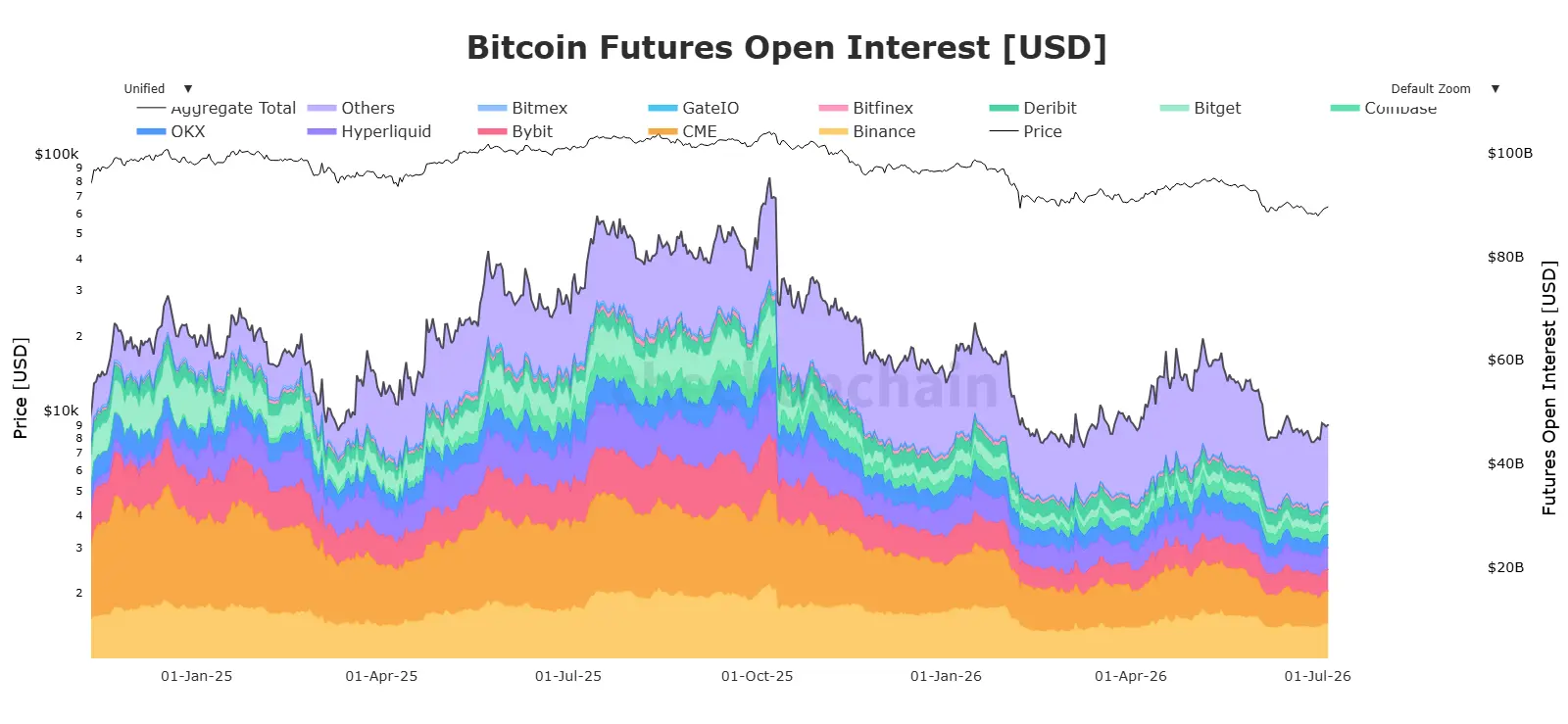
The derivatives market for the world’s largest cryptocurrency is undergoing a major transformation. Bitcoin futures open interest currently sits at $47.29B, consolidating near its lowest levels since March 2025. With bitcoin trading at $63,550, this drastic reduction in active contracts signals a major retreat of speculative capital. For investors, this shift is highly significant: it represents a massive leverage flush that redefines the rules of the game for short- and medium-term price action.
Anatomy of a Bearish Trend in Derivatives
To understand the scale of the current situation, we need to look back. Data from Checkonchain reveals that on June 29, bitcoin futures open interest bottomed out at $44.08B, nearly touching the critical low of $43.03B recorded on March 2, 2026, when bitcoin’s price hovered at $59,550.
This sequence of lower lows confirms a stark bearish trend in risk appetite within the futures market. The indicator’s last bullish peak occurred on May 6, 2026, reaching $64.16B while bitcoin traded at $80,861. Before that, on January 16, 2026, the metric reached $65.09B with the asset priced at $95,570. Both figures pale in comparison to the absolute all-time high on October 7, 2025, when open interest hit a staggering $95.27B, driving bitcoin to its record high of $124,606.
What Does the Simultaneous Drop in Price and Open Interest Mean?
In technical and financial analysis, the combined dynamics of price and derivatives speak clearly. When bitcoin’s price drops or stagnates while bitcoin futures open interest contracts, it signals a capitulation of long positions and a general lack of interest in opening new trades.
Unlike a price drop accompanied by rising open interest—which would indicate an aggressive attack by short sellers—the current setup shows that traders are simply closing their positions and moving to the sidelines. This weakens the momentum of the current downtrend, suggesting the market is searching for a solid floor rather than facing a continuous collapse. Leveraged money is exiting, leaving spot market investors in control.
The Hit to Liquidity in the Largest Crypto Market
The futures market serves as the primary source of liquidity for the global crypto ecosystem. Such a severe contraction in open contract volume translates directly into lower systemic liquidity.
As order book depth shrinks across major derivatives platforms, executing large capital flows without moving the asset’s price becomes more expensive. For both retail and institutional investors, lower liquidity means bid-ask spreads can widen, and large orders face higher slippage. The market becomes static, heavy, and less responsive day-to-day.
The Great Deleveraging: A Blessing or a Curse for Price?
The plunge in open interest is the direct result of a massive deleveraging process. Traders heavily cut their exposure to borrowed funds, which drastically reduces the potential for aggressive speculation on the cryptocurrency.
How does this impact bitcoin’s price? In the short term, it caps explosive rallies because the market lacks the leverage “fuel” to pump prices rapidly. However, over the medium term, this is incredibly healthy. Wiping out excess debt and unsustainable speculation levels drastically reduces the likelihood of facing dreaded long squeezes or cascading liquidations that often trigger 10% to 15% crashes in a matter of minutes. The price gains structural stability, building a much more organic foundation that is less vulnerable to manipulation.
A More Mature, Less Volatile Market
The drop in bitcoin futures open interest to $47.29B marks the end, at least temporarily, of the speculative euphoria that defined previous quarters. While lower liquidity demands caution, the current deleveraging cleanses the market’s foundation. Bitcoin is entering a consolidation phase where real value and spot market accumulation will carry far more weight than the leveraged bets of high-frequency traders.
Disclaimer: This article is purely for informational and educational purposes. It does not constitute financial advice, investment recommendations, or an offer to trade digital assets. Every investor must conduct their own research before making decisions in the crypto market.

Communications Professional. Crypto Enthusiast. Economic Journalist. Bitcoiner & Altcoiner.