
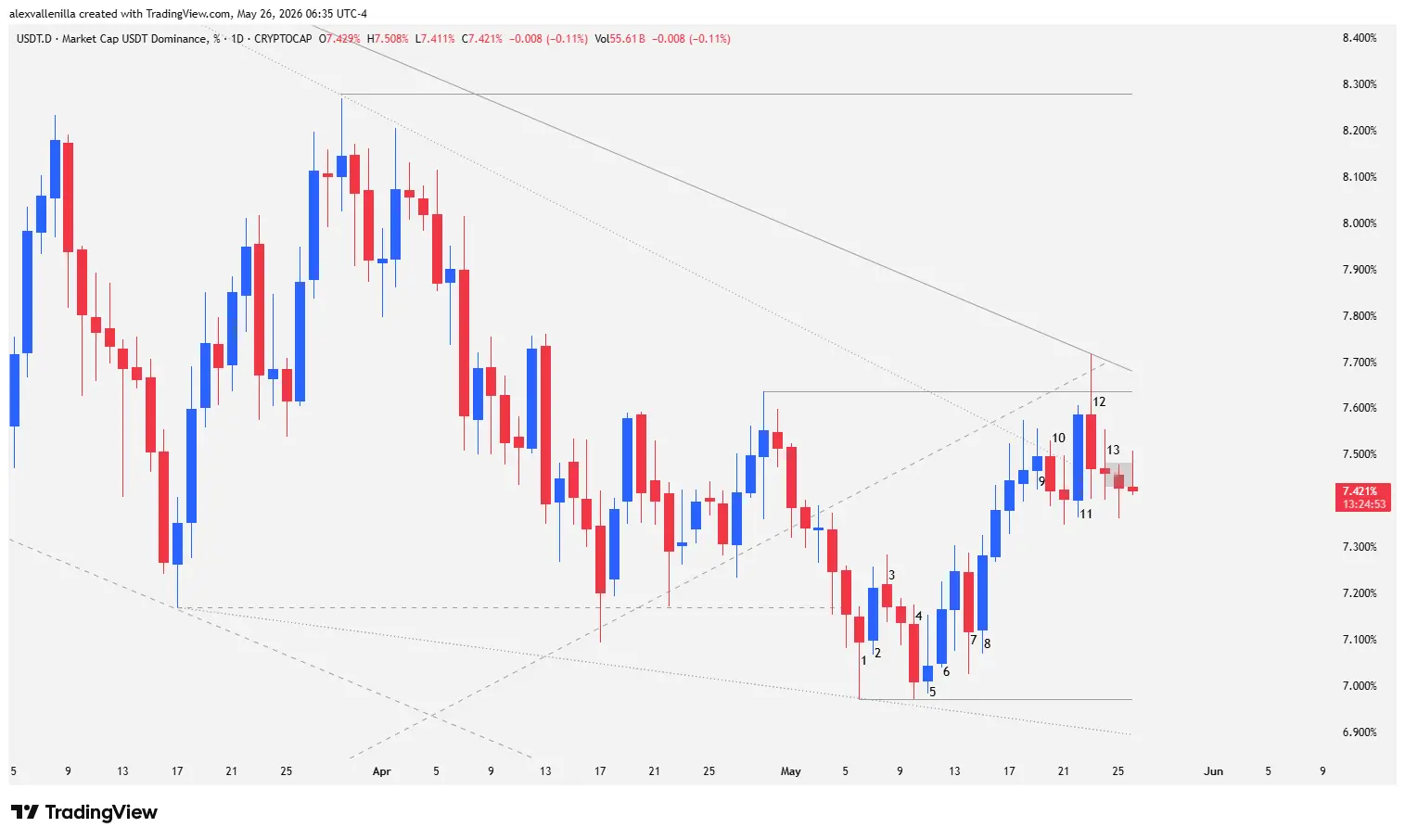
Tether Dominance (USDT.D), a critical metric for measuring risk sentiment across the crypto ecosystem, is undergoing a profound structural breakout crisis. After cracking the baseline of its main 230-bar ascending channel, the order flow reveals a severe deceleration in selling pressure. Failing to validate macro support at 6.749%, price printed a local double bottom pattern that propelled a technical bounce toward the confluence of dynamic resistances at 7.636%. This institutional rejection is stabilizing the metric within a congestion range, suggesting that relief for bitcoin and altcoins hinges on a bearish defense at current levels.
The Macro Context: Breakout Crisis and Confluence Walls
The recent behavior of USDT dominance reflects a technical phenomenon known as a “trend breakout crisis.” This happens when a major structure (in this case, a 230-bar ascending channel) is pierced, but the counter-trend move lacks the momentum required to solidify a change in direction, allowing the influence of the previous trend to linger.
Currently, price is boxed inside a counter-trend descending channel—readjusted from 105 to 109 bars. USDT.D bears (who favor a crypto rally) failed in their attempt to test the lower boundary of this channel and also missed testing key structural support at 6.749%, a former resistance that previously catalyzed the last macro bullish impulse. The subsequent bounce drove price into a literal technical Berlin Wall: the confluence of the descending channel’s upper boundary, the lower trendline of the old ascending channel (now acting as dynamic resistance), and a local static resistance at 7.636%.
Price Action: A Candle-by-Candle Breakdown
To master market psychology and actual order flow, we must break down the interaction between supply and demand across the last 13 trading bars:
The Local Floor and Supply Absorption
Bar 1: A pinbar featuring a bearish close. While its body overlapped the previous range, its lower wick established critical support at 6.971%. This price action confirmed the breach of structural support at 7.169%, originally pointing toward 6.749%. However, the lower tail revealed massive supply absorption by buyers, anchoring the lower baseline of an emerging falling wedge.
Bar 2: A naked bullish candle. Buyers attempted an immediate reversal, printing a higher high, but a lack of volume and conviction left the move unprotected.
Bar 3: A small-bodied bearish candle. Its high slightly cleared Bar 2, but failing to follow through to the upside confirmed the previous reversal attempt had failed.
Bar 4: Sellers tried to reclaim macro control, but price tested the low of Bar 1 without success, failing to close below 6.971%. This structured a micro double bottom pattern, injecting doubt into bearish continuity.
Bar 5: An inside bar marking consolidation. Note the upper wick, which measures three times the size of its body. Bears aggressively attempted to suppress any hint of a bounce after failing to break support.
The Technical Bounce and Loss of Momentum
Bar 6: A moderate bullish candle that broke above the local micro descending channel. Despite encountering selling activity at the highs (upper wick), it signaled an end to immediate downside pressure.
Bar 7: A naked bearish engulfing candle relative to the body of Bar 6. Despite the bias, its low remained higher than Bar 5’s and its close did not pierce the previous base, indicating a weak retracement.
Bar 8: Bulls trapped lagging sellers from Bar 7, confirming the failed retracement with an expansive, highly efficient +2.31% candle. From this point forward, however, candle bodies began to shrink as wicks extended, exposing a clear loss of momentum as price approached the dynamic resistance of the counter-trend channel.
Bar 9: A doji candle with a razor-thin body and an inside nature, unable to breach the ceiling of the descending channel.
Institutional Intervention and Time Compression
Bar 10: A bearish candle that engulfed and closed below Bar 9. It looked like the start of another drop, but the following bar (a long-wicked doji) offered no follow-through, proving that bears were also running on fumes.
Bar 11: Institutional volume arrives. Bulls surprised the market with a wide-range, solid, and highly efficient candle, clearing a linear breakout above the upper boundary of the 105-bar descending channel. However, the institutional order block capped the close right below static resistance at 7.636%.
Bar 12: High-volatility candle with a bearish close. Its long wicks on both ends reveal a massive battle: bulls tried to force an upside expansion, but institutional order flow liquidated positions at the ceiling of the range. The high of this bar forced a technical readjustment of the counter-trend channel to 109 bars, confirming a slowdown in the overall move.
Bar 13: An inside doji candle with a negligible body. This consolidates price, slashes volatility, and its lower high confirms the rejection at the confluence zone. The market officially enters a congestion range.
Implications for the Crypto Market: What to Expect?
A historically inverse correlation exists here: when USDT dominance drops, capital rotates into risk assets, driving up prices for bitcoin (BTC), ethereum (ETH), and the broader altcoin market.
In the current setup, the harsh rejection at the confluence of resistances and the static 7.636% area opens the door for a local bearish scenario for USDT.D. Price is on track to seek a retest of the Bar 1 support at 6.971%, a move that would provide breathing room and trigger a relief rally across major cryptocurrencies.
Conversely, if bulls manage to absorb the current selling pressure and cleanly break through the 7.636% wall, dominance would invalidate its structural weakness. This would clear a path to challenge the structural high at 8.278%, plunging the broader crypto market into a deep correction.
Disclaimer: This technical analysis is issued strictly for informational and educational purposes. Under no circumstances does it constitute financial advice, investment advice, or an offer to buy or sell digital assets.

Communications Professional. Crypto Enthusiast. Economic Journalist. Bitcoiner & Altcoiner.