
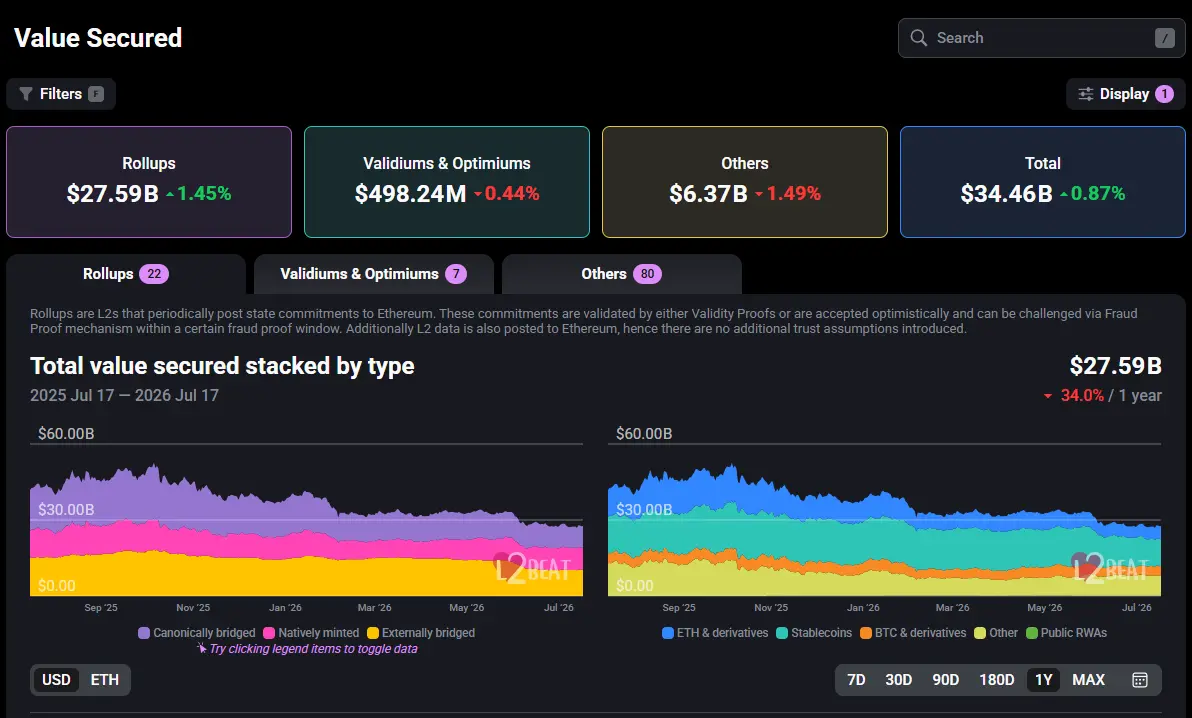
The Ethereum scalability ecosystem is facing its toughest test yet. In a year marked by volatility and shifting narratives across financial markets, the total value locked (TVL) in Layer 2 (L2) networks suffered a drastic 33.7% contraction, dropping from a robust $52.00B in July 2025 to $34.46B as of July 17, 2026. This drop of more than $17.5B reflects not only a cooling in base asset prices, but also a deep restructuring in how users and whales distribute their funds as they seek safety or more attractive yields outside the mainnet.
The Heavy Blow to Rollups and Scaling Solutions
Rollups, considered the crown jewel of Ethereum scaling, are the hardest-hit sector in this market pullback. On July 17, 2025, this category secured an impressive $41.85B. Twelve months later, that value fell to $27.59B.
This contraction in total value locked is largely explained by the drop in the price of ETH and the native tokens of these networks, but it also points to a slowdown in internal transactional activity. Nonetheless, Validiums & Optimiums solutions also experienced a contraction, declining from the $596.31M registered a year ago to $498.24M today.
Anatomy of the Collapse: The Flight of Ether and the Reign of Stablecoins
Analyzing the internal composition of assets held in rollups reveals a key defensive shift by investors:
Collapse of Ether Collateral: Combined exposure in ETH & derivatives within rollups plummeted from $10.58B (25.2% of total rollups in 2025) to just $5.08B (18.4% in 2026). This shows that users have withdrawn their ether en masse or that asset depreciation severely dented its dominance on these secondary networks.
Flight to Stablecoins: While the value in volatile crypto assets fell, the presence of stablecoins in rollups resisted the onslaught much better in percentage terms, growing their dominance from 34.5% ($14.45B) to 38.9% ($10.74B). Stablecoins are now the predominant asset sustaining operational liquidity on L2s.
Bitcoin Keeps a Low Profile: The value of BTC & derivatives on these networks changed slightly from $4.00B (9.57%) to $3.73B (13.5%), showing that bridges to Bitcoin continue to maintain a loyal but minority user base compared to the native EVM ecosystem.
Where Is Capital Flowing?
The drop in total value locked does not necessarily mean the end of L2 networks, but rather a necessary shakeout phase. With gas fees at historic lows thanks to previous upgrades, the challenge for Layer 2s is no longer just being cheap, but generating real yield incentives and user retention in the face of competition from alternative Layer 1 chains like Solana or Sui. The maturity of the DeFi market on L2 will depend on how quickly organic capital flows can be reactivated and on institutional adoption of hybrid solutions.
Disclaimer: The information presented in this article is purely educational and informational, and should not be interpreted in any way as financial or investment advice. Crypto assets and the use of Layer 2 protocols carry a high risk of capital loss. Always perform your own research beforehand.

Communications Professional. Crypto Enthusiast. Economic Journalist. Bitcoiner & Altcoiner.