
The cryptocurrency market faces one of its most critical moments so far this year. During the week ending June 5, 2026, the crypto ecosystem experienced a lethal combination of factors: a massive outflow of institutional capital, an unexpected strategy shift from the asset’s largest corporate holder, and a US macroeconomic outlook that strengthens the dollar at the expense of risk assets. For a generation of investors accustomed to the narrative of uninterrupted institutional growth, this week serves as a cold reminder that no asset is immune to global liquidity dynamics.
The Worst ETF Capital Outflow Since Early 2025
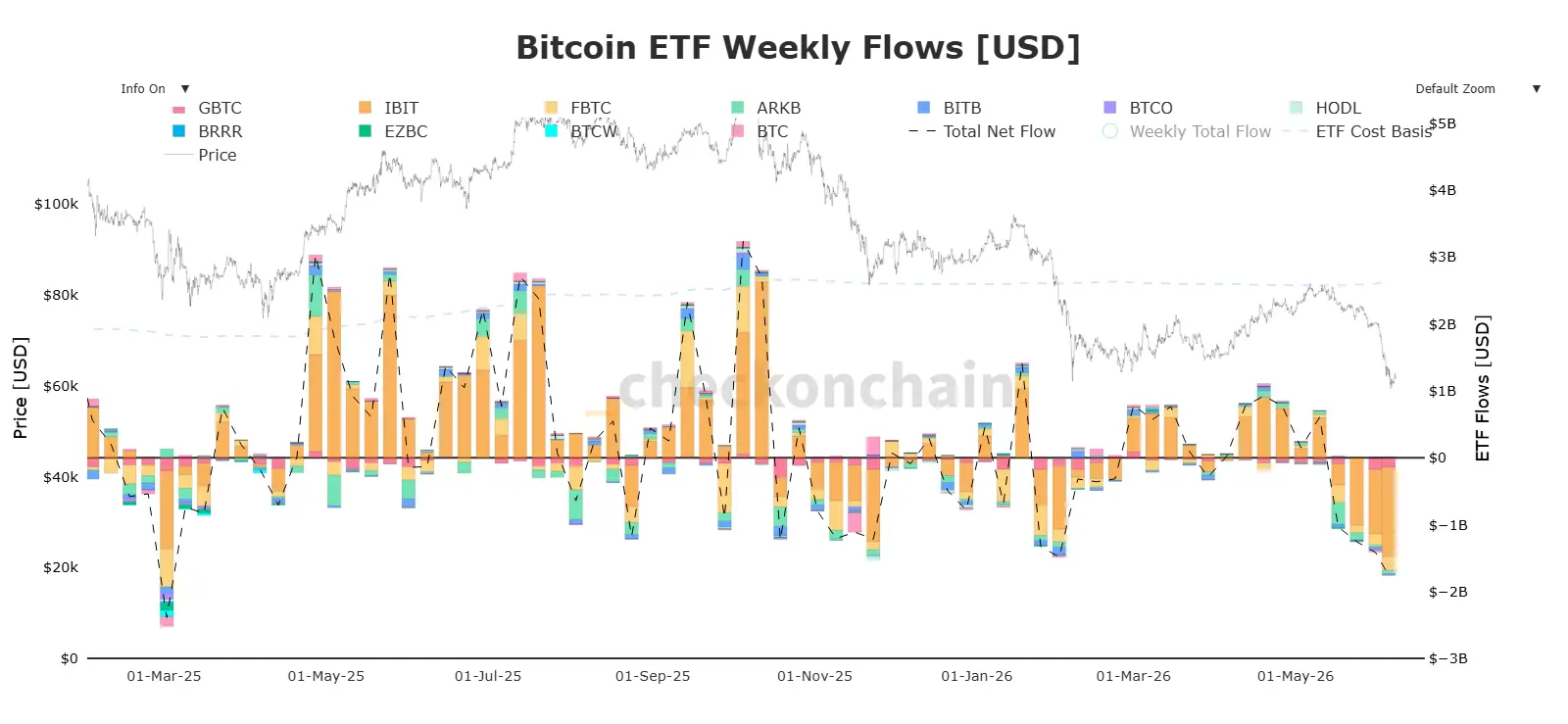
Wall Street’s appetite for the digital asset seems to have frozen after recording a fourth consecutive week of heavy capital outflows from exchange-traded funds (ETFs). According to data from CheckonChain, capital flows during the week ending June 5 hit -$1.75B, dragging the asset price down to $59,328.
This massive divestment represents the largest single-week capital outflow since March 2, 2025, when outflows bottomed out at $2.39B. The bearish trend in institutional flows had already been brewing in previous weeks, showing a steady deterioration in market sentiment:
Week ending 05/31/2026: Outflow of -$1.41B with bitcoin trading at $73,733.
Week ending 05/24/2026: Outflow of -$1.25B with a price of $75,721.
Week ending 05/17/2026: Outflow of -$1.0B with a price of $82,146.
This constant bleeding even surpassed the sharp stumble of February 1, 2026, when ETF outflows reached -$1.48B while the asset averaged $76,405.
The Saylor Factor: The 32 Coins That Broke the “HODL” Pact
Beyond the cold numbers of institutional funds, the true psychological trigger that sparked FUD (fear, uncertainty, and doubt) in bitcoin came from one of the ecosystem’s most iconic figures: Michael Saylor. A regulatory filing from MicroStrategy revealed that the company sold 32 units of the spot asset on the open market to cover distributions on its preferred stock, generating close to $2.5M.
While the sales figure is minuscule and almost insignificant compared to the massive treasury of over 840,000 coins held by the corporation, the emotional impact on retail investors was devastating. Saylor’s historical narrative relies firmly on the promise to “never sell under any circumstances.” The fact that MicroStrategy crossed that red line to pay dividends cracked the confidence of traders, who interpreted the move as a fundamental shift in the rules of the game.
A Rock-Solid Labor Market Forces the Fed to Keep Rates High
The coup de grâce for cryptocurrency prices came from the macroeconomic front in Washington. Official US employment data for May 2026 demolished the most conservative projections, proving that the American economy continues to run at full steam.
The US unemployment rate held steady at 4.3% during May, meeting general market expectations, while the total number of unemployed individuals decreased by 66,000 to sit at 7.31 million. The most shocking data point for Wall Street analysts was job creation: the US economy added 178K jobs, crushing the consensus forecast that sat at a mere 60K. The healthcare sector primarily led this rebound, adding 76K jobs following the return of workers from a previous strike, followed by the construction sector, which contributed 26K jobs.
Impact on Risk Assets: A full-employment economy and a sharply recovering manufacturing index drastically reduce pressure on the Federal Reserve (Fed) to implement an interest rate cut. Persistent restrictive monetary policy significantly strengthened the dollar throughout the week, dealing a heavy blow to equities and, especially, cryptocurrencies.
According to data from CME Group, fed funds futures market participants price in an overwhelming 96% probability that the Fed will keep interest rates unchanged at 3.75% at its next meeting. However, eyes are already on the medium term: for December 9, 2026, trader positions remain fragmented. A small minority of 48.65% estimates that the Fed will have to raise rates again to 4.0%, 25.4% project that the increase will reach 4.25%, while a tight 20% believe they will remain stable.
Market Outlook: Where Is the Price Heading?
In the short and medium term, the technical outlook for the digital asset looks highly complex. The breach of the psychological $60,000 level, combined with the temporary capitulation of ETF flows, suggests that institutional investors are seeking refuge in traditional fixed income ahead of the prospect of persistently high interest rates.
The breakdown of MicroStrategy’s absolute accumulation narrative, alongside the strengthening US dollar, will keep the market under a strict consolidation zone or further correction, where traders will closely watch whether the price manages to stabilize around the historical corporate buy average or if it will continue to look for deeper lows.
Disclaimer: This analysis is presented for informational and educational purposes only, and should not be considered under any circumstances as investment advice or financial counsel.

Communications Professional. Crypto Enthusiast. Economic Journalist. Bitcoiner & Altcoiner.